

tldr: Managed QA is a service where an external engineer owns your test coverage end to end, on a flat fee, with software doing the repetitive work and a human accountable for the result. Here's what the model actually includes, what it doesn't, and how to tell a real one from a relabeled agency.
The definition
Managed QA is a service model in which a dedicated engineer from an outside provider plans, builds, runs, and verifies your automated test suite, and is accountable for one outcome: regressions caught before they reach production. You don't operate a tool, and you don't buy blocks of tester hours. You subscribe to the result.
Vendors sell it under a few names, managed QA services, managed testing services, done-for-you QA, QA as a service, but the model underneath is the same, and so are the tests that separate it from its neighbors.
Three properties separate managed QA from everything adjacent to it:
- Someone else authors and maintains the tests. Your team's involvement is providing staging access and answering product questions, not writing test cases.
- Pricing is flat and outcome-based. A monthly fee covers the engineer, the software, and the infrastructure. No man-hour billing, no per-test metering.
- A human verifies every result. Failures arrive as triaged bug reports with reproduction steps, not as a red dashboard your team has to interpret.
If a vendor fails any of the three, you're looking at a different category wearing the label.
What the engineer actually does all week
The center of the model is a person. At Bug0 this role is called a forward-deployed engineer, an FDE, and the week looks like this:
- Plans coverage with your team. Maps your critical user flows into a test plan, sits in sprint planning and standups when useful, and adjusts coverage as the product moves.
- Authors the tests. The FDE builds the suite on Bug0's AI engine, writing flows as natural-language steps and hand-coding Playwright for scenarios that need precise control.
- Verifies every run. Human eyes on every execution. When a test fails, the FDE decides whether it's a real bug or a test issue before you ever hear about it.
- Files bugs you can act on. Video, screenshots, network logs, reproduction steps. The deliverable is a fixable report, not a failure notification.
- Gates releases. Tests run on every PR and branch through CI, and the FDE flags regressions while the change is still in review.
- Reports weekly. Coverage, pass rate, and blockers, in your Slack, email, or Teams, in your timezone.

Notice what's absent: nobody on your team writes a selector, triages a flaky run, or maintains a test environment.
What the software does
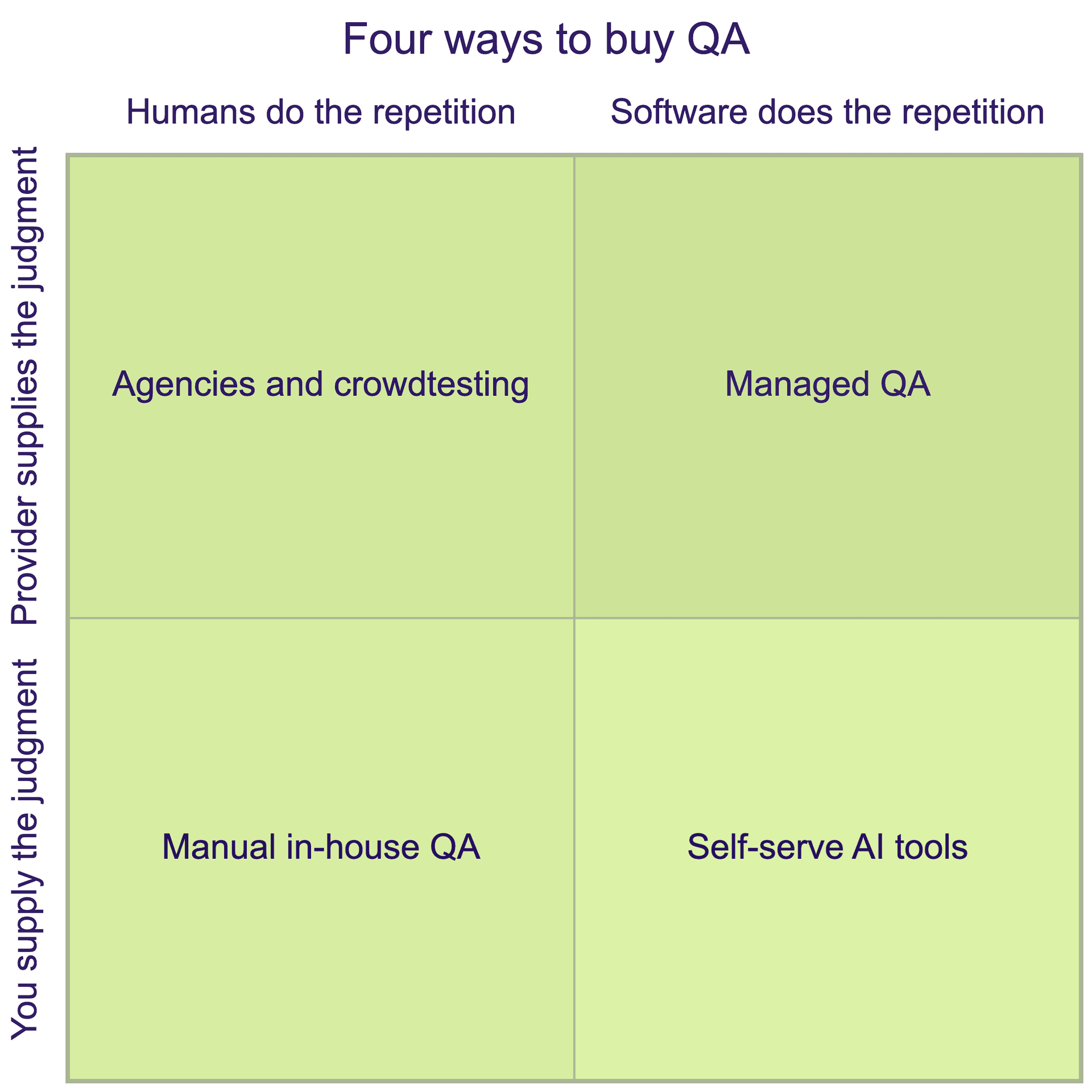
The other half of the model is the engine, and the division of labor is the whole point. Software handles repetition, humans handle judgment.
Under Bug0 Managed, the engine is Passmark, which is open source. It executes the FDE's natural-language tests through Playwright, caches successful steps so repeat runs are fast and cheap, re-resolves steps automatically when your UI changes, and checks assertions with two AI models in parallel. That self-healing loop is why UI churn doesn't generate maintenance tickets, and we've written about what makes that approach different from a browser agent demo.
The engine being inspectable matters for a service you're trusting with release decisions. You can read the code that runs your tests, which is not something the category has historically offered.
What managed QA is not
The label gets applied loosely, so the boundaries are useful.
Not a tool license. Self-serve AI testing tools are real products, but you operate them: your team writes the flows, reviews what the AI produced, and triages every failure. That labor is exactly what managed QA removes. A tool makes your judgment faster. A managed service supplies the judgment.
Not a body shop. Traditional QA outsourcing bills for tester hours, and the incentive follows the billing: more hours, not fewer regressions. Managed QA inverts this. The provider profits by making coverage cheap to maintain, which is why the model only became viable when self-healing engines made maintenance nearly free.
Not crowdtesting. Crowd platforms give you many humans exploring your app episodically. Useful for localization and device sweeps, but it isn't continuous regression coverage wired into CI.
Not a replacement for your test pyramid. Managed QA covers end-to-end browser testing. Unit tests and API tests stay with your engineers, where they belong.
Six questions that separate real managed QA from a relabeled agency
- Is the fee flat? If pricing scales with hours or test runs, the incentives are agency incentives, whatever the website says.
- Is there a coverage commitment in writing, measured in weeks? Bug0 Managed commits to 100% of critical flows in 1 to 2 weeks and full application coverage in 4. A vendor quoting quarters is telling you how much manual labor is under the hood.
- Who looks at a failure before you do? "You get a dashboard" is the wrong answer. The service should hand you triaged bugs, not raw results.
- Can you inspect the engine? An open-source core means no black box between you and your release gate.
- Where does the engineer live? In your Slack and your sprint, or behind a ticket queue? Timezone overlap and standup attendance are fair asks.
- What's excluded? Infrastructure, AI usage, parallel runs, reruns. The right answer is "nothing." Surprise metering is the old model leaking through.
What it costs
Bug0 Managed runs from $2,500 a month flat, covering up to 500 user flows with the engineer, engine, infrastructure, and unlimited runs included, and discounted 60-day pilots to start. We've published the full cost comparison against in-house hiring and traditional outsourcing separately, so this page stays about the model rather than the math. The short version: the flat fee is roughly a fifth of a fully loaded QA hire.
If you need to make that case upstairs, there's a board-level ROI model with the arithmetic shown. And if your shortlist is already down to named vendors, our QA Wolf alternatives guide covers the field.
Who shouldn't buy managed QA
The category isn't for everyone, and vendors who claim otherwise are the ones to be suspicious of.
- Pre-product-market-fit teams breaking flows on purpose every week. Coverage of a UI you're about to discard is waste. Come back when you have paying customers to protect.
- API-only and backend-heavy products. Managed QA in this form is browser E2E testing. No UI, no fit.
- Mobile-native apps. Different discipline, different tooling.
- Teams that want to operate the tooling themselves. If you have the appetite to own testing internally, use Passmark directly. It's the same engine, and it's free.
Everyone else is making a three-way choice between hiring, outsourcing, and this model. The decision guide comparing all three is the right next read.
FAQs
What is managed QA?
Managed QA is a service model where an external engineer owns your automated test coverage end to end: planning, building, running, and verifying tests, for a flat monthly fee. The customer provides staging access; the provider delivers regressions caught before production.
Is managed QA the same as QA outsourcing?
No. Traditional outsourcing sells tester hours, usually offshore, with your team still interpreting results. Managed QA sells an outcome at a flat price, with a dedicated engineer authoring tests on an AI engine that maintains and self-heals them, and verifying every result.
What is a forward-deployed engineer in QA?
A forward-deployed engineer (FDE) is the dedicated person a managed QA provider embeds with your team. At Bug0, the FDE plans coverage, authors tests on the Passmark engine, verifies every run, files bugs with reproduction artifacts, and gates releases, working in your Slack and timezone.
How fast can managed QA reach full coverage?
Vendor commitments vary widely, and the gap is diagnostic. Bug0 Managed covers 100% of critical user flows in 1 to 2 weeks and 100% of the application in 4 weeks. Providers relying on manual test authoring typically quote months.
What's included in Bug0 Managed's flat fee?
Everything: the dedicated FDE, the AI platform powered by Passmark, all cloud test infrastructure, unlimited test runs, unlimited AI credits, and CI/CD integration. From $2,500 a month, covering up to 500 user flows, with pricing pro rata beyond that.
Does managed QA replace hiring a QA engineer?
For browser E2E coverage at a 20-to-500-person company, usually yes, and at roughly a fifth of the fully loaded cost. If you need in-house quality ownership across compliance, process, and exploratory work, a hire and a managed service solve different problems, and some teams run both.