tldr: We sell AI testing. Here are five parts of QA we won't pretend AI can do alone.
The question every QA engineer is Googling in private
"Will AI replace software testers" is a real search, and it's not coming from curiosity. It's coming from QA engineers who watched AI eat a chunk of manual test-writing in eighteen months and are doing the math on what's next.
We're not the right company to hand-wave that anxiety away. We build AI testing infrastructure for a living. But selling AI testing doesn't mean pretending it does everything, and honestly, the vendors who imply it does are the ones you should be more skeptical of, not less.
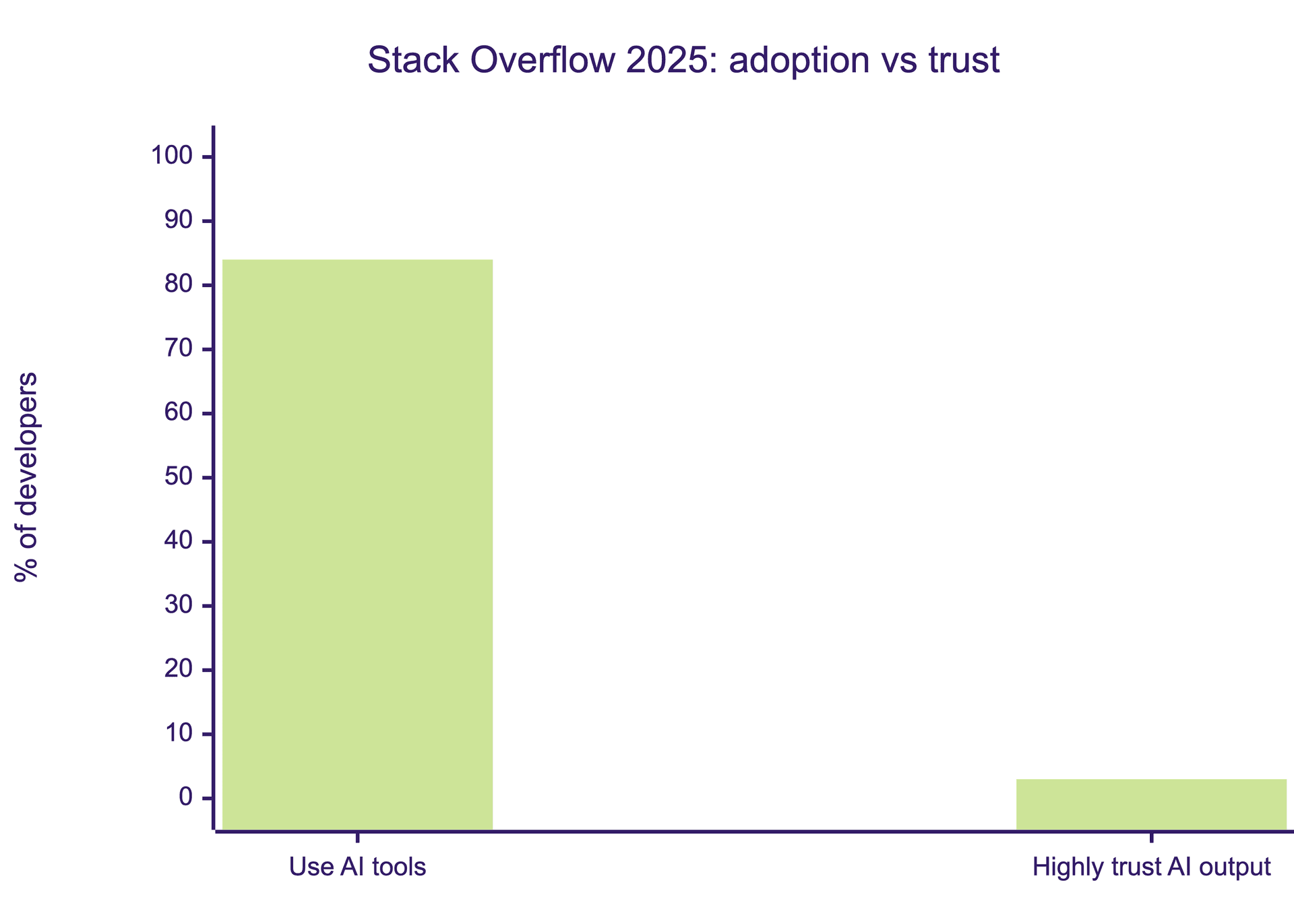
The 2025 Stack Overflow Developer Survey, which polled over 49,000 developers across 177 countries, found only 3% highly trust the accuracy of AI-generated output, while 84% use AI tools anyway. That gap between adoption and trust isn't a reason to avoid AI. It's a reason to keep a human checking its work, in testing as much as anywhere else.
AI is replacing tasks. It's not replacing judgment. Here are five jobs where that distinction still matters.
1. Deciding what's worth testing
Coverage percentage is not the same question as "does this matter." A checkout flow that handles $2M a month deserves more scrutiny than a settings toggle nobody's clicked in a year, and no AI system currently has the business context to make that call on its own. Prioritizing what to test, and what to deliberately leave lighter coverage on, is still a human judgment about risk and revenue, not a coverage metric.
2. Telling a real bug from a flaky or environmental failure
AI is good at flagging that something failed. It's much less reliable at deciding whether that failure means anything. A test that fails because a third-party API had a bad five minutes looks identical, from the outside, to a test that caught a genuine regression. Telling those apart takes someone who knows the system's history: which flows are usually flaky, which dependencies are unreliable on Tuesdays, which failure pattern they've seen before and already know isn't real.
3. Reproducing a weird, non-deterministic bug a customer reports
The hardest bugs to catch are the ones that never show up in an automated run: a race condition that only fires under real production load, a state corruption that took three specific actions in a specific order to trigger. Reproducing those takes a human who can think like the customer, try things an automated suite wasn't scripted to try, and follow a hunch that doesn't come from a test plan.
4. Owning the release-gate call
Somebody has to be the one who says "ship it" or "hold it," and somebody has to be accountable when that call turns out wrong. AI can surface a risk. It can't own the consequence of a decision. That accountability, the willingness to be the name attached to a release-gate call, is a human role by definition.
5. Understanding sprint and product context nobody told the AI about
Every team carries context that never made it into a ticket: the feature already slated for deprecation next sprint, the customer escalation that makes a certain edge case suddenly high priority, the reason a "bug" is actually intentional behavior nobody documented. AI tests the product as specified. It doesn't sit in your standups.
Why this is the case for managed, not just tooling
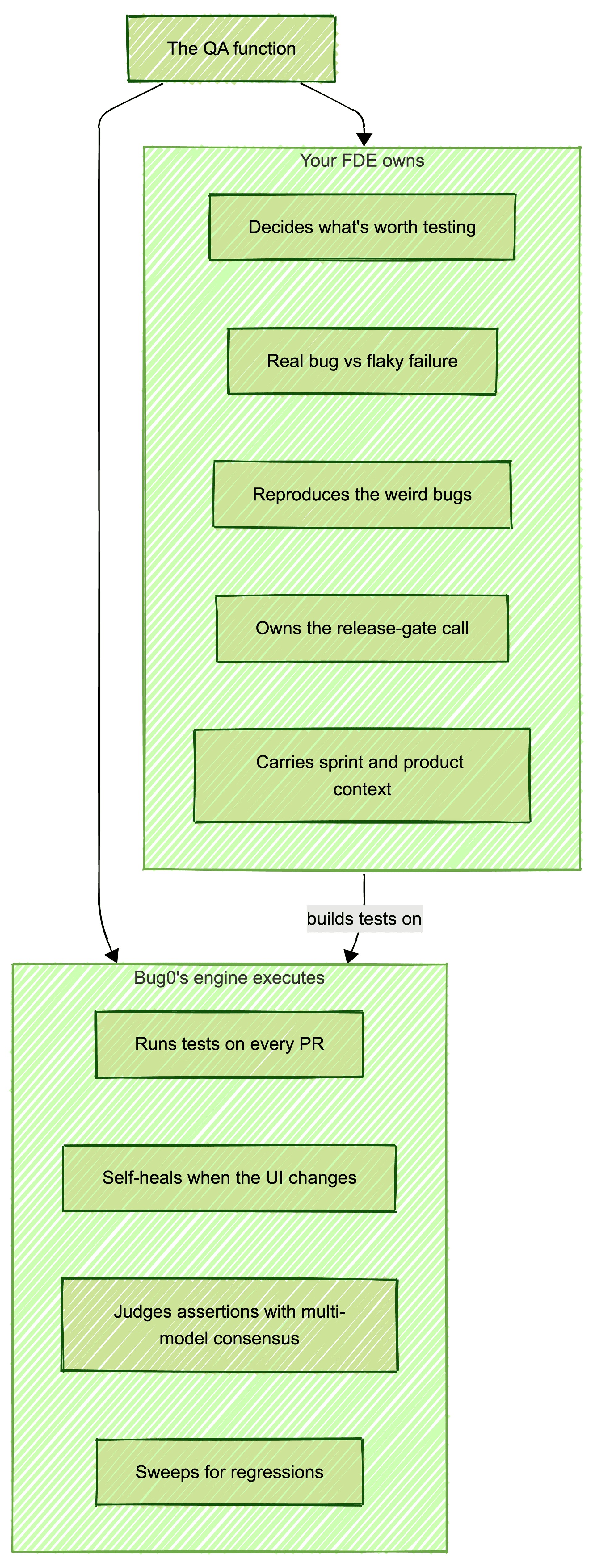
This is exactly why a tool alone doesn't close the gap, and why Bug0 Managed pairs Passmark, its open-source AI engine, with a dedicated forward-deployed engineer instead of shipping AI and calling it done. The FDE plans coverage and builds the tests on that engine, which executes and self-heals them at a speed no human matches. The FDE also owns the five jobs above: prioritization, real-bug judgment, weird-bug reproduction, release accountability, and the context that lives in your team's head, not your ticket system. If you're weighing that model against hiring, we've run the real cost comparison.
FAQs
Will AI replace software testers?
It's replacing specific tasks, like writing selectors and re-running broken scripts, faster than it's replacing judgment. The QA engineer's role is shifting toward prioritization, verification, and accountability rather than disappearing.
Can AI fully automate software testing?
AI can automate test generation, execution, and a large share of maintenance. It can't yet automate deciding what's worth testing, telling a real bug from a flaky one, or owning a release decision.
What can't AI test?
AI struggles most with things that require business context it was never given: prioritization by revenue risk, historical judgment about which failures are "normal," and non-deterministic bugs that don't reproduce in an automated run.
How is generative AI test generation different from human QA judgment?
Generative AI is strong at producing test cases, data, and scripts from a spec, covered in more depth in our guide to generative AI in software testing. Human QA judgment is about deciding what's worth testing in the first place and whether a failure is real, which generative AI doesn't do on its own.
Is fully autonomous testing possible today?
Not reliably, for anything that matters. The tooling for autonomous execution exists, but the judgment layer, deciding what to test, whether a failure is real, and who's accountable for a release, still needs a human in the loop.