
tldr: Every testing vendor calls their product "agentic" now. Most just mean an agent clicks buttons in a loop.
The word got diluted in about a year
Agentic testing wasn't a category twelve months ago. Now it's on the homepage of nearly every testing vendor. UiPath has an agentic testing platform. Mabl markets agentic testing. Autify wrote "everything you need to know" about it. TestGrid and Virtuoso QA both use the term across their marketing, and Autonoma has published a small library of posts built entirely around the phrase.
That's a lot of vendors converging on one word fast, and it's not unique to testing. The industry has a name for it: agent washing, rebranding ordinary automation as "agentic" without changing what the product does. Analysts estimate that only a small fraction of vendors claiming to build AI agents, out of thousands making the claim, are building anything genuinely agentic. Testing has caught the same fever. When everyone's product is "agentic," the term stops helping a buyer decide anything.
The word needs precision, because the gap between real agentic testing and an agent that clicks around a browser is the difference between a system you can trust and a demo that impressed someone once.
A clear definition, stated early
Agentic testing is AI that understands the intent behind a test, navigates an application dynamically to fulfill it, self-heals when the UI changes, judges pass or fail with real reasoning, and reports back with context instead of a bare boolean.
That's different from an agent that clicks buttons in a loop. Clicking buttons is an action. Understanding intent, adapting when the plan doesn't survive contact with a changed UI, and knowing when a result is actually wrong: that's judgment. Most tools marketing "agentic testing" today have built the former and are selling it as the latter.
The fake version: an agent pointed at a browser
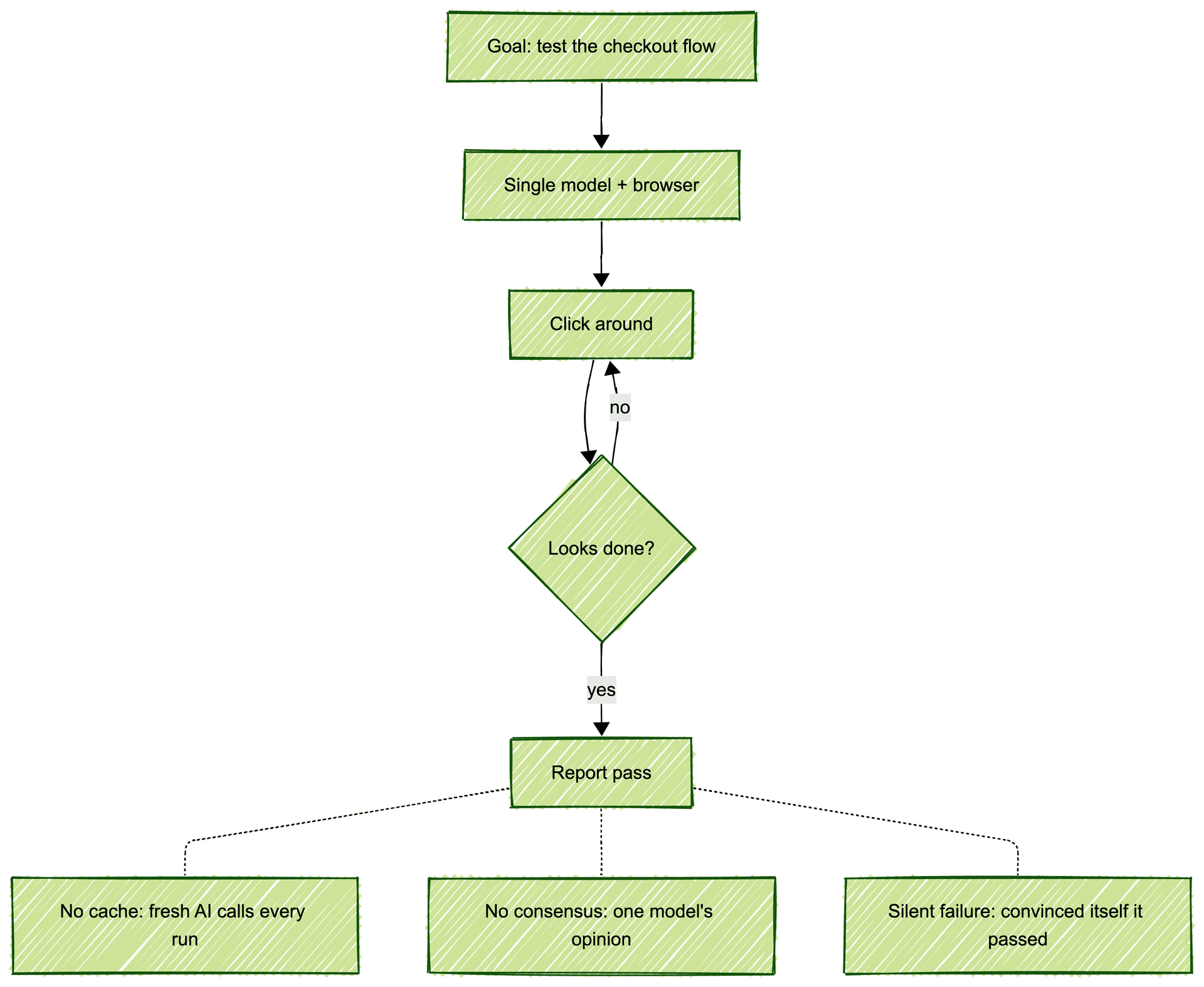
The fastest way to build something that looks agentic is to give a single model a browser, a goal, and a loop. Point it at your app, tell it to "test the checkout flow," and let it click around until something looks done.
It's an impressive demo. It's also brittle in production. A single model with no caching layer means every run costs a fresh set of AI calls and a fresh chance to wander off course. There's no consensus check on whether an assertion actually passed, just one model's opinion of what it saw. And when it fails, it usually fails silently, reporting a pass because it convinced itself the goal was met. We've written before about why this class of tool doesn't hold up at scale. Tools like Stagehand, Browser Use, and Skyvern are good at what they're built for: fast, disposable automation for a single task. The problem is treating that as a foundation for a regression suite you run on every release.
One version of this pitch deserves a direct callout: "fully autonomous, zero human in the loop." It sounds like a strength. In practice, removing the human checkpoint doesn't remove risk, it just removes the one thing that would have caught the AI being confidently wrong.
The real version: the architecture behind the word
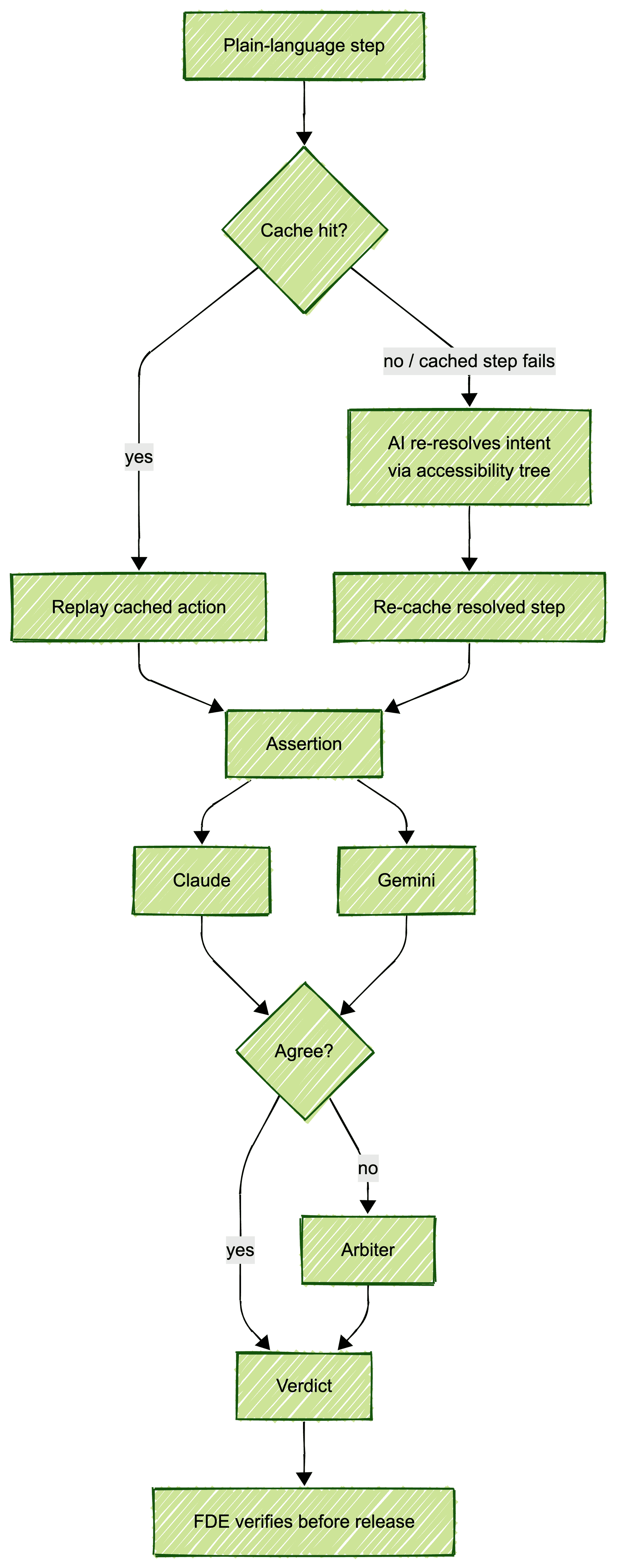
A real agentic testing architecture starts with intent capture: a step described in plain language, not a scripted click sequence. From there, execution is cache-first, so a step that's already been resolved successfully replays instantly instead of re-calling a model every run. When the UI changes and a cached step fails, the system falls back to fresh AI execution, re-resolves the step, and re-caches it. That's what auto-healing actually means, not a marketing label on top of selector retries.
Assertions run through multi-model consensus: two models evaluate the same outcome independently, and an arbiter resolves any disagreement, so a single model's hallucination doesn't decide your pass or fail. Redundancy across providers matters just as much for availability, which is why Passmark routes through an AI gateway instead of one vendor's SDK. And a human still verifies results before a release ships. This is Passmark's actual design, described plainly rather than as a pitch: intent capture, cache-first execution with auto-healing, multi-model consensus, human verification. The engine is open source at github.com/bug0inc/passmark, so none of this is a claim you have to take on faith.
How to tell the difference when evaluating a vendor
A short checklist for anyone shopping for an "agentic" testing tool:
- Does it retry intelligently by re-resolving intent, or does it just retry the same action and hope?
- Does it fail loudly when it's uncertain, or does it hallucinate a pass?
- Does a second model, or a human, ever check the first model's assertion?
- Does a successful run get cached, or does every single execution burn a fresh AI call?
If the answer to most of these is "no," you're looking at the demo tier wearing the word "agentic."
Why the distinction is the whole product
This isn't a semantic argument. It's the difference between buying a tool and buying an outcome. A tool that clicks around a browser still leaves you owning the judgment: was that pass real, is this failure worth investigating, who verifies the result before you ship. A system that clears that bar, backed by a human who verifies every run, is what lets you stop owning that judgment yourself. That's the premise behind Bug0 Managed, a done-for-you QA service: the AI does the execution, a dedicated engineer owns the accountability.
FAQs
What is agentic testing?
AI-driven testing where the system understands the intent of a test, navigates an application dynamically to achieve it, self-heals when the UI changes, and judges pass or fail with reasoning rather than a scripted assertion.
Agentic testing vs. traditional test automation?
Traditional automation executes a fixed script against fixed selectors and breaks when the UI changes. Agentic testing resolves each step from intent at runtime, so it adapts to UI changes instead of failing on them.
Is agentic testing reliable?
It depends entirely on the architecture. A single model clicking around a browser with no caching or consensus check is not reliable enough to run a regression suite on. An architecture with cache-first execution, multi-model consensus, and human verification is a different, much more reliable proposition.
Does agentic testing replace QA engineers?
It replaces the repetitive parts: writing selectors, re-running scripts, chasing broken locators. It doesn't replace the judgment calls: what's worth testing, whether a failure is a real bug, and who's accountable for a release decision.
What's the difference between agentic AI and RPA in testing?
RPA (robotic process automation) executes a fixed, scripted sequence of actions and breaks when the underlying UI changes. Agentic AI testing resolves what to do from intent at runtime, so it adapts instead of breaking.