
tldr: You have three real options for QA today: build in-house, outsource to a traditional agency, or use an AI-native managed service. The math between them isn't close.
Most teams never run the numbers
When testing starts hurting, the default move is posting a QA engineer job req. It feels like the obvious next step, so most teams never compare it to the alternatives.
That's a mistake, because the options have changed more than the job req has. You can still hire in-house. You can still outsource to a traditional QA agency. Or you can use an AI-native managed service that didn't exist three years ago. Each comes with a different cost structure, a different timeline to coverage, and a different answer to "who owns this when it breaks."
Run the numbers before you post the req.
Option A: build an in-house QA team
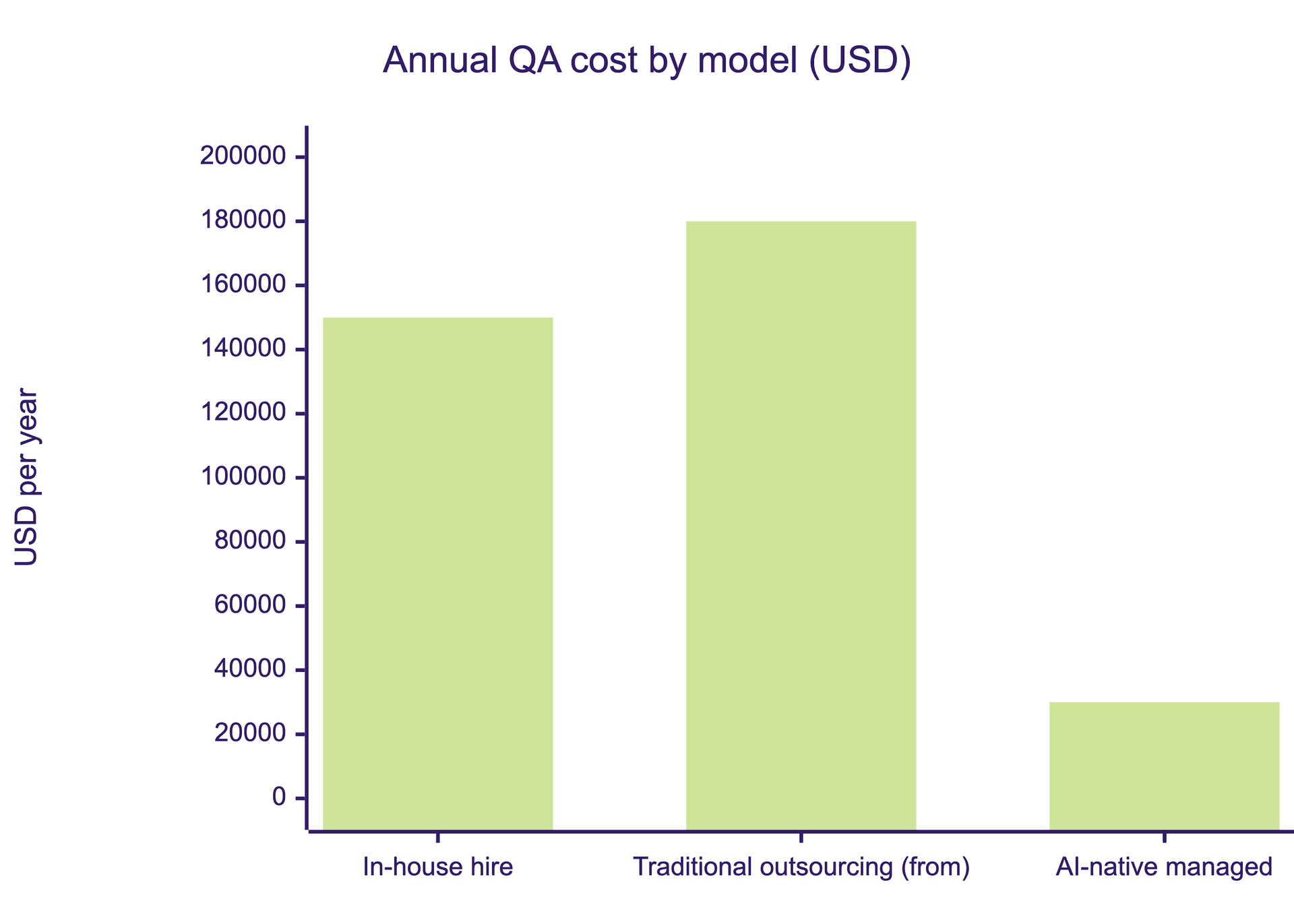
The most familiar option, and the most expensive. Base salary data from Glassdoor and Indeed puts the average US QA engineer around $95,000 to $101,000, with senior roles reaching $170,000 or more. Add the standard 30-40% for benefits, payroll taxes, and overhead, and a mid-level hire's fully loaded cost lands at $130,000 to $150,000 a year. On top of that, you're paying for test automation tooling ($5,000 to $15,000 a year) and cloud test infrastructure ($3,000 to $10,000 a year). We've broken down the full math elsewhere.
The hidden cost isn't the salary. It's the ramp time. A new hire needs weeks to understand your product before they can write meaningful tests, and if they leave, that knowledge leaves with them. And once a suite exists, maintenance eats into everything: flaky tests alone can burn six figures a year in engineering attention.
Option B: traditional QA outsourcing
Hand testing to an external agency, and you're typically looking at $15,000 to $50,000 a month, billed by the hour or by a headcount-equivalent model. This is where the legacy QA-services industry lives: firms that staff a team of testers against your product on a retainer.
The math is better than a full-time hire at small scale, but the model is still built around human hours, not outcomes. You're paying for time spent, not necessarily coverage delivered, and ramp-up looks a lot like Option A: weeks of onboarding before the agency understands your product well enough to test it properly.
Option C: AI-native managed QA
This is the newest option, and the one most cost comparisons don't even list yet: QA as a service, sometimes called done-for-you QA, where a dedicated engineer builds and runs your test suite on an AI engine, priced flat instead of by the hour.
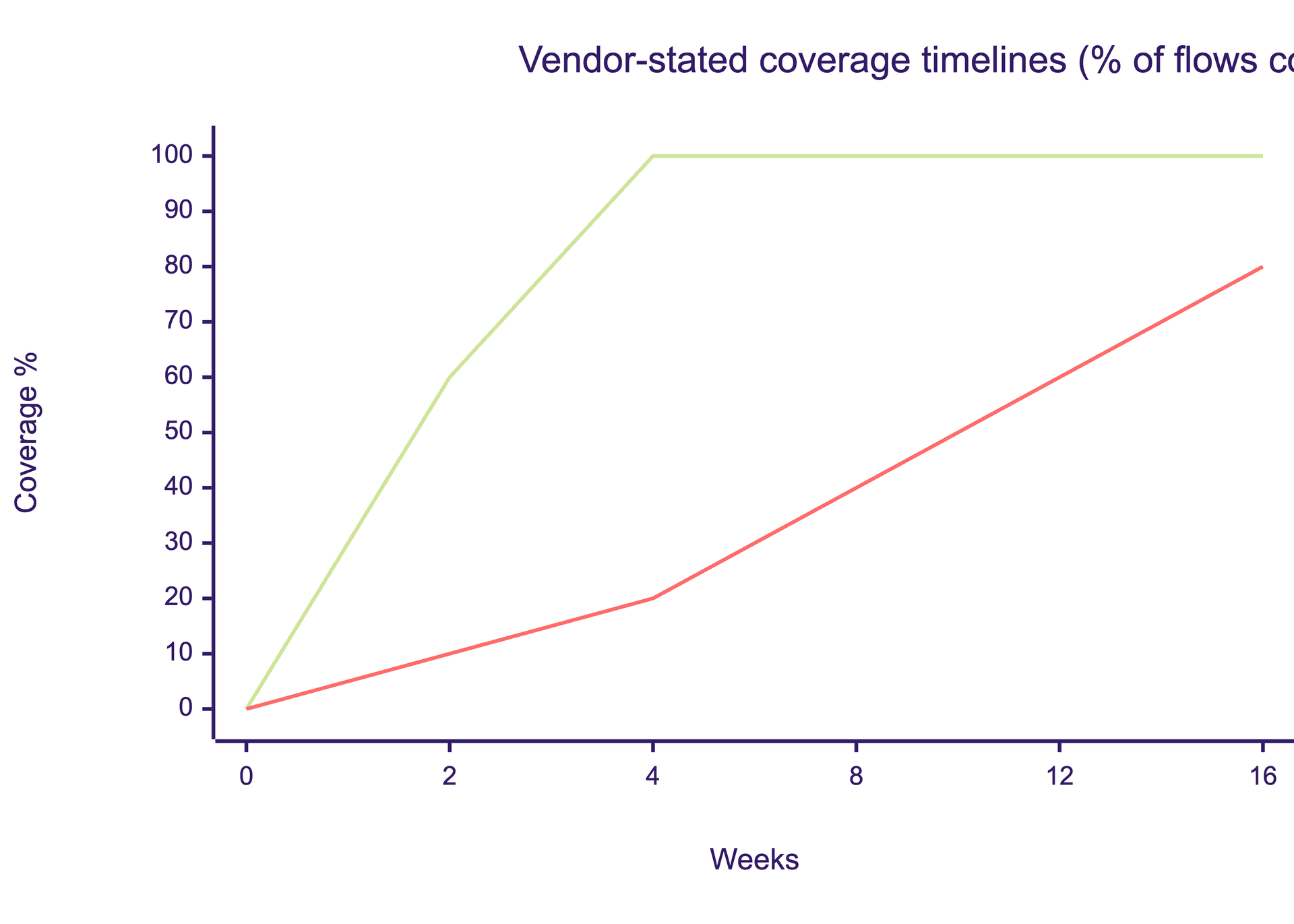
Bug0 Managed is one example of this category, alongside players like QA Wolf and MuukTest. What separates the AI-native tier from Option B is the pricing model and the speed to coverage. Bug0 Managed runs from $2,500 a month flat, covers 100% of your critical user flows in 1 to 2 weeks, and reaches 100% of full application coverage in 4 weeks. For context, QA Wolf, the closest comparable managed offering, has quoted 80% coverage in 4 months. That's a meaningfully different timeline for a meaningfully different price.
The pitch of this category isn't "cheaper hours." It's an outcome, delivered on a subscription, with a dedicated engineer who plans, builds, verifies, and gates releases as part of your sprint instead of billing against a ticket queue.
There's a fourth category that gets confused with this one: self-serve AI testing tools and open-source AI agents, like Momentic, Octomind, or Autonoma, that you install and operate yourself. Those are real, often cheaper on paper, but you're still the one running the tool: reviewing what it generated, deciding whether a failure is real, and owning the release call. Managed QA is what you buy when you want that judgment handled for you, not just the software that makes judgment faster.
The real cost comparison
| In-house hire | Traditional outsourcing | AI-native managed QA | |
|---|---|---|---|
| Setup time | Weeks of hiring + ramp-up | 2 to 4 weeks of onboarding | Results in week 1 |
| Time to full coverage | Months, depends on the hire | 3 to 6 months typical | 4 weeks |
| Monthly cost | ~$11K-13K equivalent | $15K-50K | From $2,500 |
| Annual cost | $150K+ (salary + tools + infra) | $180K-600K | ~$30K |
| Who owns maintenance | You | The agency, billed hourly | Included, flat fee |
| Billing model | Fixed salary | Hourly / man-hour | Outcome-based, flat |
When each option actually makes sense
Not every team should land on the same answer.
- Pre-seed, pre-revenue, shipping fast and breaking things on purpose: none of these yet. Manual testing by the founding team is fine until you have paying customers to protect.
- Series A/B, 20 to 500 employees, shipping weekly, no dedicated QA: this is where AI-native managed QA fits best. You get coverage fast without adding headcount you can't yet justify.
- Enterprise, complex compliance requirements, multiple products: traditional outsourcing or an enterprise-tier managed pod, both of which can scale to dedicated teams and custom SLAs.
- You already have an in-house QA team and want to augment it: managed QA can still make sense here, layered on top to cover the flows your team hasn't gotten to yet.
FAQs
What is managed QA?
Managed QA is a service where an external team, human or AI-assisted, owns your testing function end to end: planning coverage, building tests, verifying results, and gating releases, typically for a flat recurring fee instead of hourly billing.
Is managed QA the same as QA outsourcing?
They're related but not identical. Traditional QA outsourcing usually bills by the hour or by headcount, with humans doing most of the test-writing manually. In AI-native managed QA, a dedicated engineer builds your tests on an AI engine that maintains and self-heals them. The engineer verifies every result and owns accountability, typically at a flat monthly price.
How much does outsourced QA cost in 2026?
Traditional agencies typically run $15,000 to $50,000 a month. AI-native managed QA services like Bug0 Managed start at $2,500 a month flat, covering up to 500 user flows. We break down what the modern model includes on our QA outsourcing page.
How fast can a managed QA service get me to full coverage?
It varies by vendor. Bug0 Managed reaches 100% of critical user flows in 1 to 2 weeks and 100% of full application coverage in 4 weeks, compared to the 3 to 6 months typical of traditional outsourcing.
What's included in Bug0 Managed's flat monthly fee?
A dedicated forward-deployed engineer, the AI testing platform powered by Passmark, Bug0's open-source engine (test generation, self-healing, reporting), all cloud test infrastructure, unlimited AI credits, unlimited test runs, and CI/CD integration. No separate charges for the tool, the AI, the infrastructure, or the human.