
tldr: Black box testing evaluates software by its inputs and outputs, without access to the underlying code. The model has been stable for nearly five decades: four techniques (boundary value analysis, equivalence partitioning, decision tables, state transition) across three categories (functional, usability, regression). What's different now is the cost of producing the test cases. AI handles case derivation, environment setup, and test execution. Humans still own scope, risk, and the judgment calls that decide whether the resulting suite is any good.
A user types their password wrong three times. The account locks. They reset it, log in, and find their cart is empty. Three things just happened. Unit tests cover the password logic. Integration tests cover the cart persistence. Whether the system behaved correctly across all three events is a different question. Answering it is the job of black box testing.
Back when I was writing application code for a living, this was the testing category I cared about least and respected most. I didn't write the tests. The QA team did. But I always knew which engineers I trusted, and they were always the ones who actually thought about what a black box test was for.
Black box testing catches the gap between what your code does and what your user experiences. The name comes from electronics: a sealed component's internals are invisible to whoever's testing it. In software, the metaphor becomes a posture: test what your user can observe, not what your engineer can read.
In software engineering, this is the testing that lives closest to the customer. Let me walk you through what it actually covers now, and where the labor has shifted.
What is black box testing? It tests behavior, not implementation
Black box testing is a software testing method that evaluates an application by its inputs and outputs, without access to the underlying code or structure. The loop has three steps:
-
Provide an input.
-
Observe the output.
-
Compare to expectation.
If the output matches the expectation, the test passes. If it doesn't, you have a bug. The tester never reads the code.

Black box testing is the discipline of testing what your user experiences, not what your engineer wrote.
This makes it the only category of testing that mirrors how a customer actually meets your product. The user doesn't see your component tree or your schema. They see a screen, type a value, and either get what they expected or don't.
The black box testing process
The discipline has six stages, from reading the spec to closing the defect ticket:
-
Requirement analysis. Read the spec or user story. Identify what the system should do.
-
Test planning. Decide scope, environment, schedule, and ownership.
-
Test case design. Apply the techniques (BVA, equivalence partitioning, decision tables, state transition) to derive cases.
-
Test environment setup. Provision staging, seed data, and configure browsers.
-
Test execution. Run the cases. Capture pass and fail.
-
Defect reporting. File bugs, triage, and verify fixes.
Steps 1 and 2 are judgment calls about scope and risk. They stay human work, because automating them well requires context that lives in your head and your Slack threads, not in your test framework. Steps 3, 4, and 5 are where AI now does most of the production work. Read the spec, derive the cases, spin up the browser, run the tests, capture results. Step 6 splits: triage stays human, reporting is increasingly automated.
The discipline survives the shift. The headcount it used to require does not. Anyone selling you a black box testing primer that doesn't name which stages an agent now owns is selling you 2015 advice in a 2026 wrapper.
Black box testing examples: four scenarios that show the model
The clearest way to understand black box testing is to see it applied. Four scenarios, each pinned to a recognized technique:
Login flow (functional + state transition). Enter username and password, click submit, and verify the dashboard renders. Wrong password three times locks the account. Functional testing validates the basic flow. State transition covers the lock-after-three-attempts behavior. The tester never sees the auth code.
E-commerce checkout (decision table). Four binary conditions decide the final price: coupon applied or not, cart over the free-shipping threshold or not, domestic or international, express or standard. Two states each, 16 combinations to verify. A boundary case sits inside: cart at $49 versus $50, when free shipping kicks in at $50.
Search functionality (equivalence partitioning). A search box accepts a query string. Partitions: exact match, partial match, no match, special characters, empty string. One test per partition covers an infinite input space. The thinking is identical whether the backend is Postgres full-text or Elasticsearch.
API endpoint validation (boundary value analysis). POST /users with payloads that exercise the limits of every accepted field. Email at 254 versus 255 characters. Age at 17 versus 18. Username at 3 versus 4. Status codes are the assertion: 201 valid, 400 invalid, 422 validation errors.
The four black box testing techniques, and what each one actually rewards
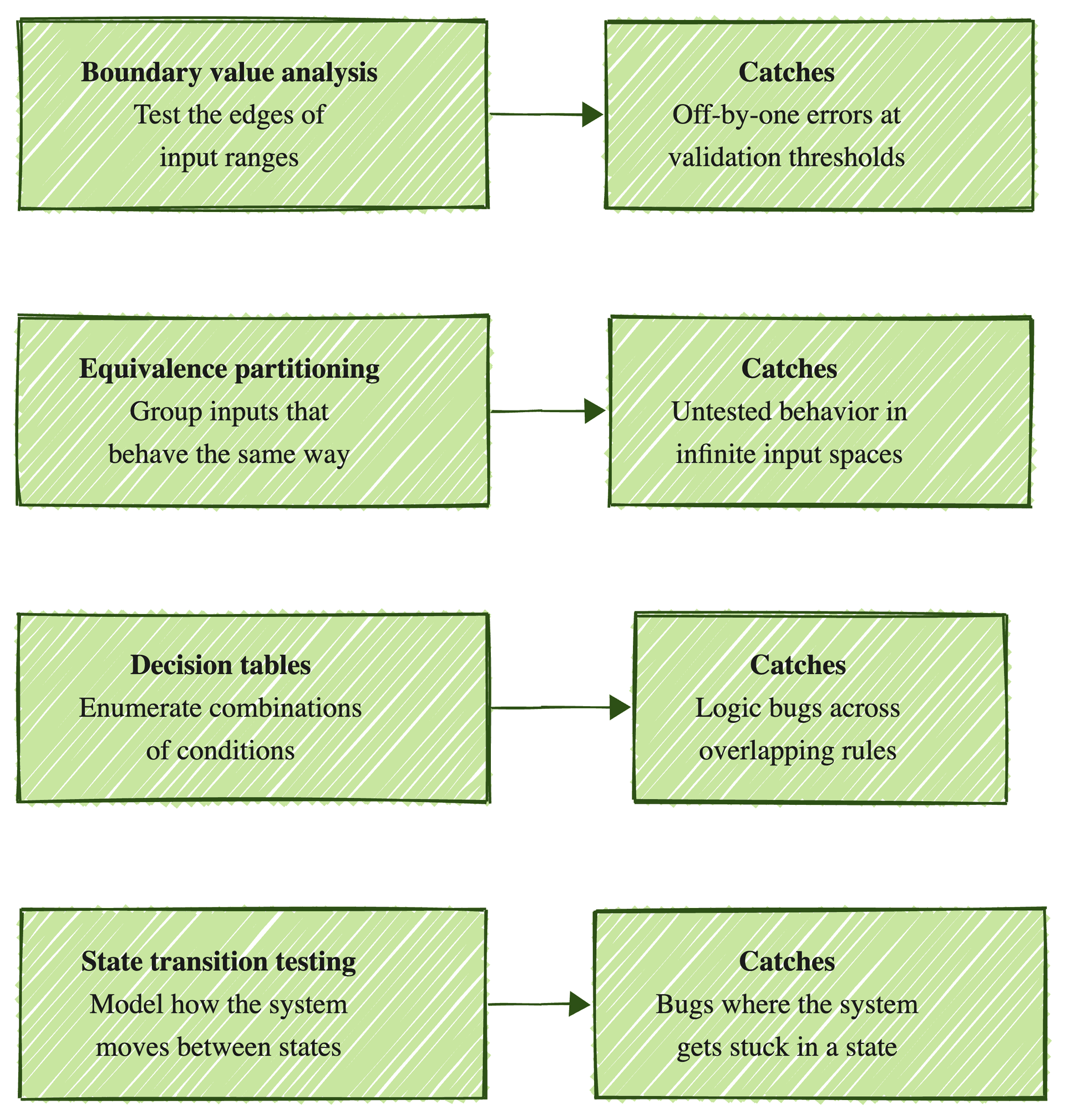
Four techniques carry most of the work in black box testing:
-
Boundary value analysis. Test the edges of input ranges.
-
Equivalence partitioning. Group inputs that behave the same way.
-
Decision tables. Enumerate combinations of conditions.
-
State transition testing. Model how the system moves between states.
The lineage runs back to Glenford Myers' The Art of Software Testing (1979). The ISTQB syllabus recognizes error guessing as a fifth, and Wikipedia's list runs to eleven once you include cause-effect graphs, all-pairs, use case testing, user story testing, domain analysis, and syntax testing.
The four above are the load-bearing ones. James Bach, who maintains the Heuristic Test Strategy Model, makes the deeper point cleanly:
"Yes, ECP is a technique, but a better word for it is 'heuristic.' A heuristic is a fallible method of solving a problem. ECP is extremely fallible, and yet useful."
That's the right framing for every technique on this list. They're heuristics for designing tests, not algorithms for executing them. The thinking is the technique. Let me show you how each one works.
Boundary value analysis
Boundary value analysis (BVA) tests the edges of input ranges, because that's where most defects live. If a field accepts 1 to 99, you test 0, 1, 2, 98, 99, and 100.
This works because programmers write off-by-one errors:
-
if (age > 18)when they meant>= -
for (i = 0; i < n; i++)when they meant<= n
The defect lives at the boundary. Testing the boundary catches the defect.
The classical workflow asks you to identify every field, document its valid range, enumerate the six boundary values, and write the cases. For a checkout form with twelve fields, that's seventy-two cases. In 2026, an AI agent reads the form, infers the validation rules from the schema, and generates the boundary cases without a spreadsheet ever existing. The thinking is still BVA. The work of writing it down collapsed.
Equivalence partitioning
Equivalence partitioning splits your input space into groups that the system will treat the same way, then tests one value from each. For a field that accepts ages 1 to 99, the partitions are:
-
Below 1 (invalid)
-
1 to 99 (valid)
-
Above 99 (invalid)
-
Non-numeric (invalid)
-
Empty (invalid)
Five tests cover an infinite input space. This is the most powerful idea in test design, not because it catches the most bugs, but because it gives you a defensible answer to "did you test enough."
The catch is judgment. Two values are equivalent only if the system actually treats them the same. If your validation has a special case for ages 13 to 17 (parental consent flow), your "valid" partition is wrong. You needed three partitions inside the valid range, not one.
An AI agent, given the schema and a few examples, drafts a partition set. A QA engineer sets the partitions and corrects them. The engineer owns the thinking. The agent does the typing.
Decision table testing
Decision tables describe systems where the output depends on a combination of inputs. A billing engine is the classic example:
-
Annual plan + over 50 seats + US → 12% discount
-
Default → 5% discount
-
2023 legacy contract → 8% discount (overrides the rest)
You can write that as prose or a nested if block. Neither will catch the bug where a 2023 annual contract for 51 seats gets the wrong rate. A decision table enumerates every combination and assigns an outcome.
This is brilliant in theory and unmanageable past five conditions. Four binary conditions = 16 combinations. Ten = 1,024. The combinatorial explosion has always been the challenge with decision tables.
AI agents now generate the table from prose and collapse redundant rows automatically. You read the table; you don't write it. The technique survived the explosion.
State transition testing
State transition testing models a system's states, the events that move between them, and the transitions allowed:
-
States: logged out, logged in, password locked, account suspended
-
Events: correct password, wrong password three times, admin override
-
Tests: cover every transition (correct password from locked = stays locked)
State machines describe almost every interaction in your product. Signup, password recovery, multi-step checkout, subscription lifecycle, two-factor auth, payment retry. If you've shipped a bug where a user got stuck in an "almost paid but not really" state, your model had a hole.
State transition is the technique where AI assistance is most uneven. Agents are decent at executing tests once a model exists. They're poorer at building the model. Inferring a state machine from a UI is a synthesis problem, not a generation problem.
Across 200+ customer onboardings, this is where our forward-deployed engineers still spend most of their thinking budget. We generate the test cases in minutes once the model exists. We spend a day with the engineering team to build it first.
Types of black box testing: functional, usability, regression
Black box testing is most often categorized by what you're testing rather than how you're testing it:
-
Functional testing. Black box testing applied to feature behavior. Does the checkout button process payment?
-
Usability testing. Black box testing applied to the interaction itself. Can a user actually find the checkout button?
-
Regression testing. Black box testing is applied repeatedly to behavior that already works. Does the checkout button still process payment after this week's deploy?
Other recognized types include smoke testing (quick sanity check after a build), acceptance testing (final validation against business requirements), and non-functional testing (performance, security, accessibility).
Techniques describe how you design the tests. Categories describe which surfaces you point them at. A good test plan names both. Equivalence partitioning applied to the signup form's email validation. State transition applied to the subscription lifecycle. That specificity is the line between a working QA program and a "we run Selenium" program.
Black box testing tools in 2026
The tool stack splits into three categories:
-
Framework-based E2E. Playwright, Selenium, and Cypress. You write tests in code; the framework drives the browser. Maximum control, maximum maintenance. Right fit for teams with dedicated SDET headcount.
-
AI-driven black box testing. Bug0, QA Wolf, Mabl. An AI engine derives and maintains the suite from a test plan. With managed options like Bug0, a forward-deployed engineer owns the authoring and upkeep, so your team operates nothing. Right fit for teams without a dedicated QA hire.
-
Specialized platforms. BrowserStack and Sauce Labs for cross-browser execution. Applitools for visual regression. They solve one slice at scale. Right fit when that slice is your bottleneck.
| Category | Examples | Maintenance burden | Best fit |
|---|---|---|---|
| Framework-based E2E | Playwright, Selenium, Cypress | High | Teams with SDET headcount |
| AI-driven black box testing | Bug0, QA Wolf, Mabl | Low | Teams without a QA hire |
| Specialized platforms | BrowserStack, Sauce Labs, Applitools | Medium | Teams hitting one bottleneck |
The category matters more than the product. Teams that pick a product before the category often spend two quarters wrestling a tool that's solving the wrong problem.
Black box vs white box testing
Black box testing and white box testing are not competing methods. They answer different questions.
| Property | Black box | White box |
|---|---|---|
| What the tester sees | Inputs and outputs only | Source code, control flow, data flow |
| What it proves | The system behaves correctly from the user's perspective | The implementation covers all branches, paths, and conditions |
| Where it lives | E2E, integration, acceptance, regression | Unit tests, code coverage, static analysis |
| Who runs it | QA engineers, testers, AI agents, end-user proxies | Developers, peer reviewers |
| Defect it catches | Wrong behavior, broken flows, missing features | Logic errors inside functions, untested branches |
| Where it fails | Cannot see hidden code paths that the user doesn't trigger | Cannot prove the feature does what the user needs |
The two answer different questions and are most useful in combination.
White box proves your code does what you wrote. Black box proves your code does what you sold. Most production systems need both: white box for confidence in implementation, black box for confidence in behavior.
Black box and white box aren't the only two options. Gray box testing sits between them, with partial visibility into internals like schemas and API contracts but no access to the implementation code. Most mature teams run black box, white box, and gray box testing together, using each where it fits.
There's a coverage distinction worth knowing, too. Black box testing measures test coverage (the percentage of requirements tested). White box testing measures code coverage (the percentage of statements, branches, or paths executed). Different denominators, different questions. Both numbers can be high while the product is still broken.
Advantages and disadvantages of black box testing
Advantages:
-
No code access required. Testers can validate behavior without an engineering background, which broadens who can run tests.
-
User-perspective coverage. The defects caught are the ones a customer would actually hit.
-
Vendor- and language-agnostic. The same test works whether the backend is Go, Rust, or Python.
-
Reusable across releases. Tests written against requirements survive refactors of the underlying code.
Limitations:
-
No visibility into untested paths. Code branches that the test inputs don't exercise stay invisible.
-
Specification dependency. A vague or wrong spec produces vague or wrong tests.
-
Slower to debug. When a black box test fails, the root cause sits somewhere inside the sealed system, which takes more steps to isolate than a failing unit test.
The advantages are why black box testing has stayed central for five decades. The limitations are why most production systems pair it with white box testing rather than picking one.
What changed in 2026
The economics of writing test cases shifted. A BVA matrix that ate a senior QA engineer's afternoon now drops out of a prompt in four minutes. Two hundred test cases used to be a week of work. It is a coffee break now.
Here is the part I think most teams have not internalized:
The thinking model has not changed. What collapsed is the cost of producing the artifact at the end of each step. If your QA process still tracks "test cases written" as a productivity metric in 2026, you are paying senior engineers to do a typing job.
The teams winning right now restructured around one reviewer governing an agent fleet. Legora (AI for legal, Series B) and Dub (open-source link attribution platform) routed their regression to Bug0 for this exact reason. A forward-deployed engineer sits in your Slack, owns test design, triage, and release sign-off. $2,500 a month flat. Most "AI testing" tools still bill you for the typing job your team should not be doing in 2026. Bug0 bills you for the outcome.
FAQs
What is black box testing in simple words?
Black box testing is the practice of testing software by checking what comes out for a given input, without looking at the code that produces the output. The tester acts as a user; the system is treated as a sealed box.
What is an example of black box testing?
Entering a password into a login form, clicking submit, and confirming the user is redirected to the dashboard is a black box test. The tester doesn't need to read the authentication code to evaluate whether the test passed.
What are the four black box testing techniques?
-
Boundary value analysis. Testing the edges of input ranges.
-
Equivalence partitioning. Testing groups of inputs that behave the same way.
-
Decision tables. Testing combinations of conditions.
-
State transition testing. Testing how the system moves between states.
The first three address how inputs map to outputs. The fourth addresses how the system's state changes over time. The ISTQB syllabus also recognizes error guessing as a fifth.
How does the black box testing process work?
Six stages: requirement analysis, test planning, test case design, test environment setup, test execution, and defect reporting. In 2026, steps 3 through 5 are increasingly handled by AI agents while steps 1, 2, and the triage piece of step 6 stay human work.
When should you use black box testing?
Use black box testing whenever you care about what the user experiences rather than how the code is written: validating features against requirements, checking end-to-end flows, and running regression on every release. It's the default for QA, acceptance, and E2E testing. Pair it with white box testing when you also need confidence in internal code paths.
What is the difference between black box and white box testing?
Black box testing evaluates behavior from a user's perspective without code visibility. White box testing evaluates the code itself, including branches and paths that may never be reached by a user. They also measure different things: black box covers requirements (test coverage), white box covers statements and branches (code coverage).
What tools are used for black box testing?
The market splits into three categories:
-
Framework-based E2E: Playwright (dominant), Selenium (longstanding), Cypress
-
AI-driven black box testing: Bug0, QA Wolf, Mabl
-
Specialized platforms: BrowserStack and Sauce Labs (cross-browser), Applitools (visual regression)
Each takes a different stance on whether the human writes the test logic or the AI does.
Is automation testing black box or white box?
Most automation is black box. Selenium, Cypress, Playwright, and similar frameworks drive the application from the outside without inspecting code internals. White box automation exists (mutation testing tools, coverage-driven generators), but it's a smaller category, mostly in unit test pipelines.
What is gray box testing?
Gray box testing (also spelled grey box testing) sits between black box and white box. The tester has partial visibility into internals (schemas, API contracts, logs) without reading the implementation code. Most engineering teams already do this without naming it, because designing useful E2E tests usually requires understanding the system's data model.
The discipline that stays closest to the user
Black box testing has been stable for nearly five decades because the question it answers hasn't changed: Does the software behave the way the user expects? Everything else, including the techniques, the tooling, and now the AI agents, is in service of answering that one question more thoroughly.
What changed in 2026 is the cost of producing the answer. The matrix, the spreadsheet, the TestRail project: these were artifacts of a world where writing test cases consumed most of a QA engineer's day. That world is closing.
The quality of the thinking is the only thing left to optimize for. Pair black box testing with white box testing for code-level confidence. Pick the technique that matches your input shape. Let the agents handle the production work. Use the time you save to test the surface area you couldn't afford to cover before.
That's the program that compounds.