
tldr: A test scenario is a one-line statement of something to verify, like "a user can check out with a saved card." It names what to test, not how. Each scenario expands into one or more test cases that carry the steps, data, and expected results.
What is a test scenario?
A scenario is the unit of coverage conversation. It is short enough to read aloud in a planning meeting and concrete enough that everyone knows what it covers. "Verify checkout with a saved card." "Verify an expired card is rejected with a clear message." "Verify a downgrade takes effect at the end of the billing period."
Product managers and stakeholders can review a scenario list and spot what is missing. Nobody reviews four hundred detailed test cases. The intermediate layer exists so coverage can be argued about before it gets expensive.
Scenario versus test case
| Test scenario | Test case | |
|---|---|---|
| Answers | What should we verify? | Exactly how do we verify it? |
| Length | One line | Steps, data, expected results |
| Audience | Whole team, stakeholders | Testers and automation |
| Count for one feature | A handful | Several per scenario |
Take the scenario "a user cannot log in with wrong credentials." It expands into cases for a wrong password, an unknown email, a locked account, and empty fields, each with its own test case carrying exact inputs and the exact expected error.
One scenario, four cases. The scenario keeps the intent reviewable; the cases make it executable.
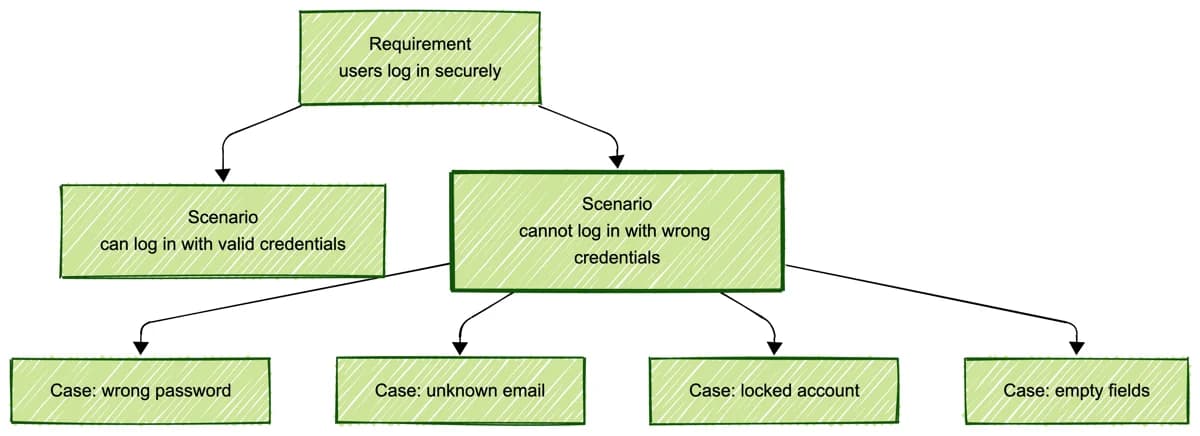
A third term floats nearby: a test script is a case written out for a non-engineer to execute step by step, or as automation code. See UAT test scripts.
How to write test scenarios
Three steps, applied story by story:
- Walk each requirement or user story.
- Ask two questions: what must a user be able to do, and what must not be possible. The second is the one teams forget; it is where negative testing enters the plan.
- Write each answer as one line that names the behavior, not the steps.
Ten scenarios for a checkout, written in a few minutes:
- Guest completes a purchase with a new card
- Logged-in user checks out with a saved card
- A declined card shows a recoverable error
- An expired coupon is rejected with the right message
- A valid coupon adjusts the total correctly
- Cart contents survive login mid-checkout
- Tax matches the shipping address
- An order confirmation email arrives
- Stock going to zero mid-checkout is handled
- The back button after payment does not double-charge
Reading that list, a product manager will immediately ask about the missing one, which is the point. Scenario 10 alone justifies the exercise.
Where scenarios live in the process
Scenarios come out of test planning and test design, then decompose into cases, which group into suites for execution. Scenario, case, suite: one hierarchy.
In a managed setup the scenario list is also the contract between customer and tester. It is the level at which Bug0's forward-deployed engineer agrees coverage with a customer before authoring the tests underneath it.
FAQs
What is the difference between a test scenario and a user story?
A user story describes something a user wants and why. A scenario states one thing to verify about the built behavior. One story typically produces several scenarios, including failure paths the story never mentions.
Is a test scenario the same as a BDD Scenario?
No. In BDD tools like Cucumber, Scenario: is a Gherkin example with Given/When/Then steps, which makes it closer to a test case. In test design, a scenario is the one-line parent those steps implement. Related, not the same artifact.
How many test cases does one scenario produce?
Between one and roughly six. Past that, the scenario is too broad; split it so failures still point somewhere specific.
Do automated tests need scenarios?
Yes, arguably more than manual testing does. An automated suite without a scenario layer becomes a pile of scripts nobody can audit for gaps. The scenario list is the map of what the suite actually protects.

