
tldr: Negative testing feeds an application input it should reject: wrong formats, out-of-range values, broken sequences. The point is proving the system fails safely with a clear error instead of crashing or corrupting data. Positive testing proves the software works; negative testing proves it is safe to use.
What is negative testing in software testing?
A negative test deliberately does the wrong thing. Submit the form empty. Paste an emoji into the phone field. Upload a 2 GB file where the limit is 10 MB. Hit step three of a wizard by URL without completing step one. Pay with a card that will decline. ISTQB's definition is compact: testing a component or system in a way for which it was not intended to be used. The practice also goes by error-path testing or failure testing.
The pass condition inverts: the test passes when the application refuses correctly. Refusing correctly means a specific, human-readable error, no crash, no half-written records, and no information leaking about internals.
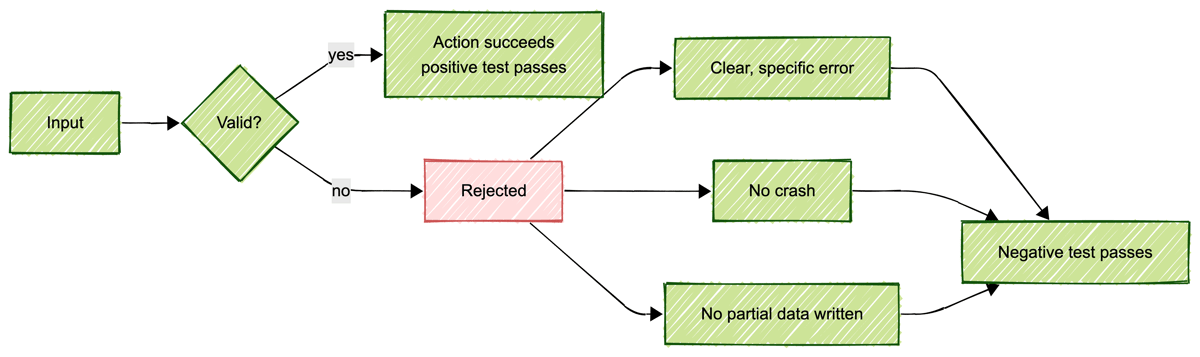
Positive versus negative testing
| Positive testing | Negative testing | |
|---|---|---|
| Input | Valid, expected | Invalid, unexpected, hostile |
| Proves | Features work as specified | Failures are handled safely |
| Pass looks like | The action succeeds | The action is rejected well |
| Typical share of cases | The majority | A deliberate minority |
Both run against the same features. A checkout suite without negative cases has only tested the customers who behave.
The main categories of negative cases
- Format violations. Wrong types, malformed emails, invalid JSON against an API endpoint.
- Range violations. Values just outside every limit: equivalence partitioning supplies the invalid classes, and boundary value analysis pointed at the invalid side supplies the exact values.
- Sequence violations. Steps out of order, double submissions, back-button replays, expired sessions mid-flow.
- Authorization probes. User A requesting user B's records by changing an ID in the URL.
- Resource failures. A declined card, a timeout from a third-party API, an upload cut off halfway.
The last two categories overlap with security and resilience testing, which is not a coincidence. Most exploits begin as unhandled negative cases.
A worked example: signup form
A signup form with email, password, and an age gate at 18 yields a compact nine-case negative suite:
| Input | Expected refusal |
|---|---|
| Empty submission | All three fields flagged as required; no create request sent |
| Email without an @ | Inline email-format error |
| Email of 300 characters | Length error from the field, not a server 500 |
| Password of spaces | Password rules error; not accepted as filled |
| Age 17 | The age message specifically, not a generic failure |
| Age -1 | Rejected as invalid input, not treated as under 18 |
| Age 200 | Rejected as out of range |
| Double-click on submit | One account created, not two |
| Replay after session expiry | Fresh session required; no half-created account |
Each row maps to a bug class that has shipped to production somewhere. The age 17 and double-click rows carry the real lesson: rejection quality is the subject. A generic "something went wrong" fails the age case even when the signup was blocked.
How much negative testing is enough
Scale it by blast radius:
| Flow risk | Negative depth |
|---|---|
| Payments, auth, anything that deletes data | Full sweep of all five categories |
| Preferences, cosmetics, low-stakes forms | Format and empty-input checks |
A useful heuristic: for every flow, write the three ways a distracted user breaks it and the one way a hostile user would try. Fold the results into your functional testing suite rather than keeping them as a separate afterthought.
FAQs
What is a negative test case?
A test case whose expected result is a defined refusal: the exact error message, no crash, no data written. It uses the same test case template as a positive case; only the expected-result column inverts.
Is negative testing the same as error handling testing?
Error handling testing is the largest slice of it. Negative testing also covers sequence abuse and authorization probes, where the correct outcome is refusal rather than an error message.
Can negative tests be automated?
Almost all of them, and they automate well because expected outcomes are precise. Declined-card and timeout cases need sandbox support from the third party, which most payment and auth providers supply.
Why do negative tests find so many security bugs?
Because attackers and negative tests use the same inputs. The difference is intent. A missing check found by a negative test in staging is the same missing check an attacker finds in production.

