
tldr: End-to-end (E2E) testing checks a complete user journey through the real application: browser, APIs, services, database, all of it. A unit test proves a function works. An E2E test proves a customer can actually sign up, pay, and get what they paid for.
What is end-to-end testing?
An end-to-end test drives the application the way a user does. It opens a real browser, clicks through a real flow, and asserts on what the user would see. Everything behind the UI runs for real: the frontend, the API layer, background jobs, the database, and often third-party services like payment or email.
That is the defining property. Lower-level tests isolate pieces of the system. E2E tests refuse to isolate anything, because the bugs that hurt most live in the gaps between pieces that each pass their own tests.
What a typical E2E test covers
Take a subscription signup flow. One E2E test would:
- Load the marketing site and click the signup CTA
- Create an account with a fresh email
- Enter card details in the embedded payment form
- Land on the dashboard and confirm the plan is active
- Check that the welcome email went out
Five steps, and they cross the frontend, the auth service, the billing provider, the database, and an email queue. No unit or integration test exercises that chain in one pass.
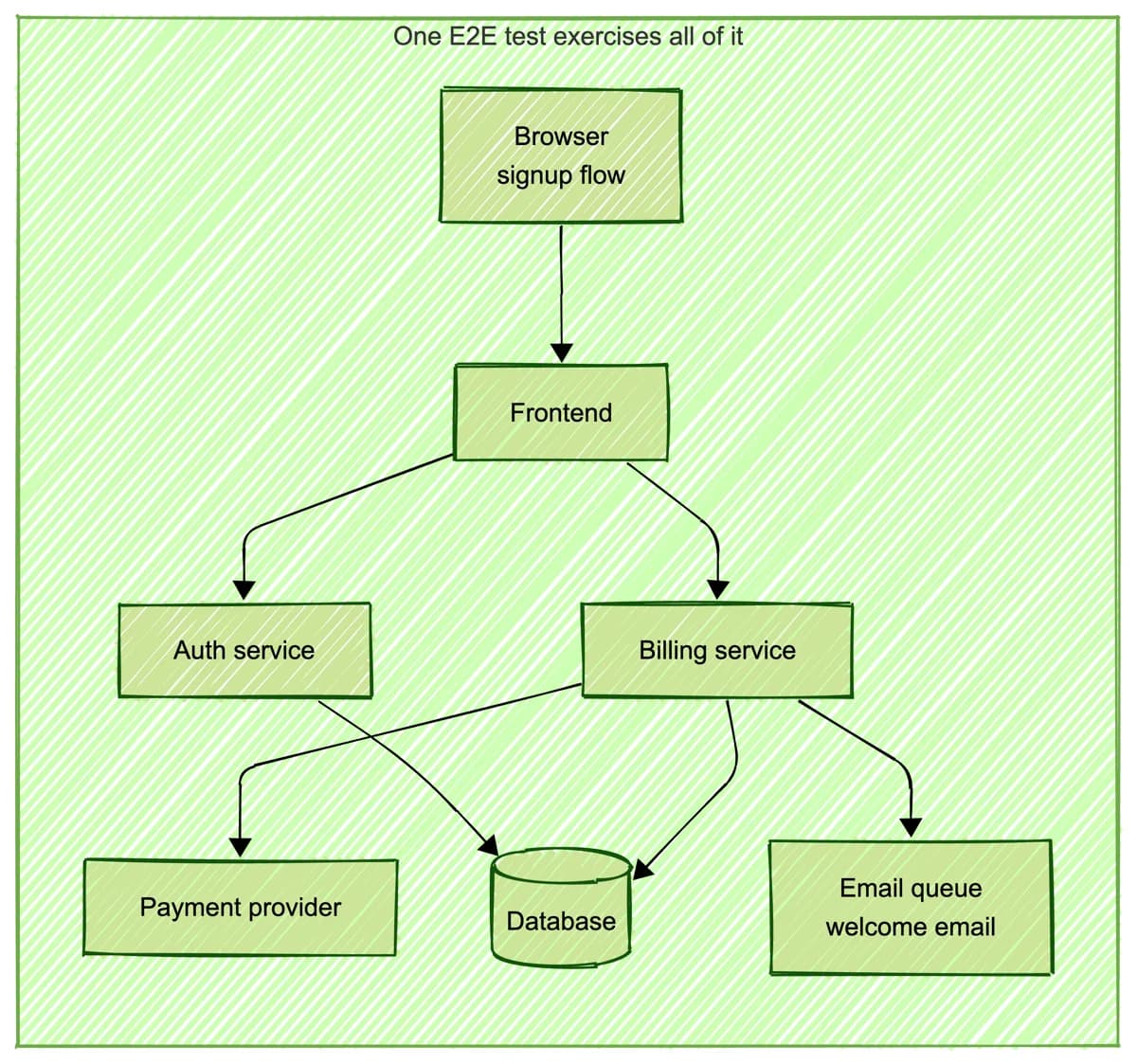
Where E2E fits among other test types
E2E sits at the top of the testing pyramid, above unit and integration tests. The layers answer different questions: unit tests prove the logic works, integration tests prove real pieces connect, and E2E proves the product works for a user. End-to-end testing vs integration testing draws that boundary in detail.
A suite needs all three. E2E tests are the fewest in number because each one is slower and touches more, but they are the only level that catches a working codebase assembled into a broken product.
Horizontal vs vertical end-to-end testing
Practitioners split E2E testing into two named types.
Horizontal E2E testing follows one user across the application, the way the signup example above does: one person moves from the marketing site through account creation, payment, and the dashboard. This is what most teams mean by E2E, and it is the type that maps to revenue-critical journeys.
Vertical E2E testing follows one action down through the stack: a single form submission traced from the UI through the API and service layer into the database. Teams use it to validate an architectural slice before the full journey exists, and to pin down which layer corrupts the data when a horizontal test fails.
| Type | Path it follows | Example |
|---|---|---|
| Horizontal | Across the app, one user journey | Signup through checkout to confirmation |
| Vertical | Down the stack, one action | A submitted form traced from UI to database row |
Why teams still need it
A system where every component passes its own tests can still fail as a product. Each service honors the contract it was tested against, and the contracts drift apart: a renamed field, a changed date format, a config value that differs between environments. Unit and functional checks all stay green, and checkout is broken anyway.
E2E tests exist for that failure class. They are the only tests that judge the assembled product the way a customer will, which is why teams keep them even though they cost more per test than anything else in the suite.
Why E2E testing has a reputation for pain
Three reasons, all real:
- Flakiness. Timing, test data, and third-party dependencies make E2E tests fail intermittently without a code bug behind the failure.
- Maintenance. UIs change constantly, and every change can break selectors in dozens of tests.
- Speed. A browser-driven test takes seconds to minutes, so large suites need parallelization to stay useful in CI.
The maintenance problem is the one that kills most E2E efforts, and it is the one self-healing automation now addresses directly: when tests repair their own selectors, maintenance stops capping how much journey coverage a team can keep alive.
What to cover first
Do not try to E2E-test everything. Start with the flows where a failure costs revenue or trust: signup, login, checkout, the core action your product exists for. Cover those deeply, run them on every deploy, and let regression testing at lower levels handle the rest.
Where Bug0 fits
Bug0 Managed is end-to-end testing run as a service. A forward-deployed engineer plans your coverage and authors the journey tests on Bug0 AI, the engine; the engine executes them on every deploy and heals them when the UI changes; the engineer verifies every result before it reaches you. Details and pricing are on the end-to-end testing service page.
FAQs
What does end-to-end mean in testing?
It means the test spans the entire system, from the user interface through backend services to the data layer. The user-facing path runs for real; edges owned by third parties, like payment processing and outbound email, usually run against sandboxes and mail catchers rather than live production services.
Is E2E testing the same as system testing?
Close, but not identical. System testing validates the whole application against its requirements, often environment by environment. E2E testing validates user journeys, and usually includes external integrations that system testing may stub.
How many E2E tests should a team have?
Fewer than you think. Most SaaS products get strong protection from 30 to 150 well-chosen journey tests, because the number follows critical paths rather than a coverage percentage: a product has a bounded set of journeys that cost revenue or trust when they break. Growth beyond that should follow real incidents and new surface area, not a quota.
Is manual testing end-to-end testing?
A manual tester clicking through a flow is performing an end-to-end check, but the term usually refers to automated browser tests that run repeatedly on every build or deploy.

