
tldr: Integration testing checks that specific components work together, one seam at a time. End-to-end testing checks a full user journey through the assembled system, browser to database. Integration failures tell you exactly where to look. E2E failures tell you whether the product actually works.
The difference between end-to-end and integration testing
Both test types use real components instead of mocks, which is why they blur together in conversation. The difference is scope and vantage point.
An integration test stands inside the system and checks one seam: this service and its database, this API and its consumer. An end-to-end test stands where the user stands and checks the whole assembly: open the app, do the thing, see the result.
| Integration testing | End-to-end testing | |
|---|---|---|
| Scope | One seam between components | A complete user journey |
| Entry point | API, service interface | The UI, usually a browser |
| Speed | Seconds | Seconds to minutes |
| Maintenance | Contracts and fixtures | UI, test data, and environment |
| Cost per failure | Low: localized to the seam | High: a whole journey to trace |
| Failure points at | The specific seam under test | Anywhere in the journey |
| Blind spot | The assembled whole | Which seam actually broke |
Two precisions on "real." An integration test's real is the seam under test; everything beyond that seam can be stubbed. An E2E test's real is the path a user takes, with only third-party edges sandboxed. And on the maintenance row: selector-healing tooling cuts E2E maintenance, not diagnosis time and not runtime.
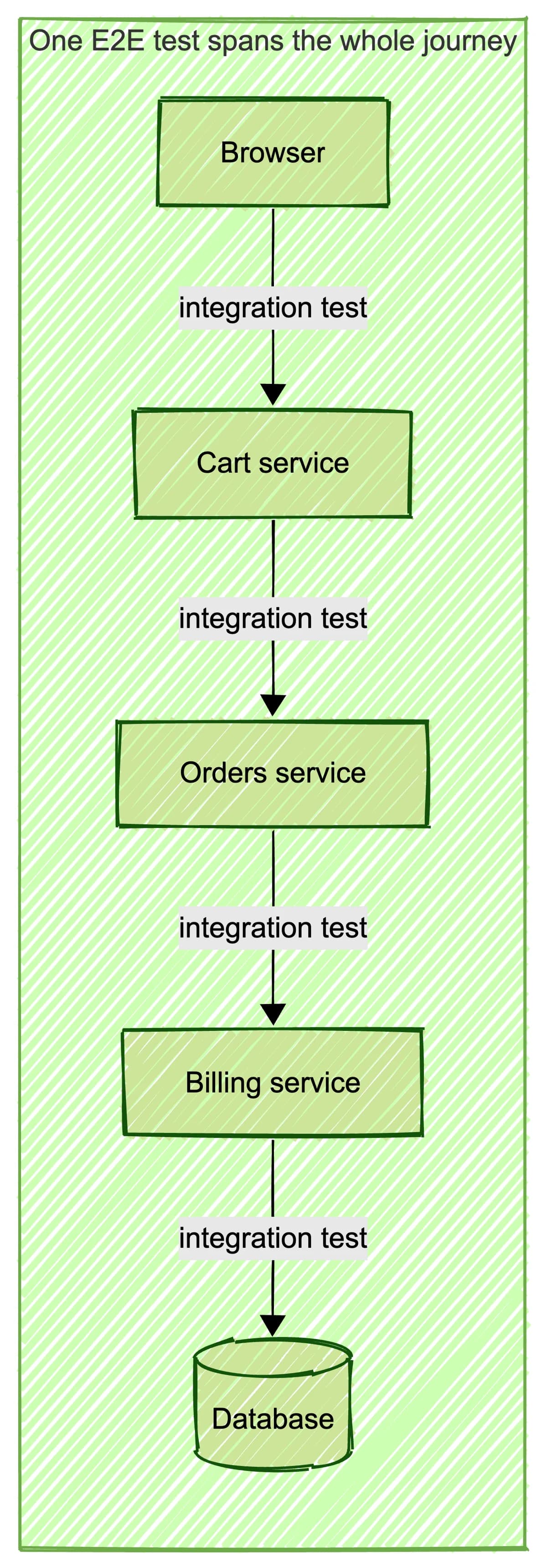
The same bug from both vantage points
A team renames a field in the orders service: total_cents becomes amount_cents. The billing service was never updated.
The integration test for the orders-to-billing seam fails within seconds of the change reaching CI, and the failure message names the missing field. Diagnosis takes one look.
Without that integration test, the bug surfaces in the nightly E2E regression run: "checkout journey failed at the confirmation step." True, and useful, since it proves customers cannot buy. But the failure could sit in the frontend, the cart, payments, or the database. Someone spends an hour tracing it to the renamed field.
Same bug. The integration test is the better detector; the E2E test is the better proof of consequence. This asymmetry is the whole argument for keeping both.
What each layer catches alone
Integration tests alone miss emergent failures: every seam checks out pairwise, yet the journey breaks. A session cookie set by one service is dropped by a redirect three steps later. No single seam owns that bug; only the assembled flow exposes it.
E2E tests alone make every failure a mystery hunt, and their runtime caps how many can run per deploy. Teams that lean entirely on E2E build slow suites that fail vaguely, one of the ways the testing pyramid inverts into the ice cream cone.
Choosing the split
Put an integration test on every seam you own: each service pair, each external API, the database layer. Put E2E tests on the journeys where failure costs revenue or trust, per what to cover first. When both layers exist, let the integration layer absorb detail and keep E2E focused on the handful of flows that define whether the product works. Unit testing sits below both, covering the logic inside each component.
FAQs
Is end-to-end testing a type of integration testing?
Taxonomically yes, it integrates everything at once. Operationally treating them as one layer is a mistake, because they fail differently, run at different speeds, and answer different questions. The vertical E2E variant, one action traced down the full stack, is the shape most often confused with a deep integration test; the E2E entry covers that split.
Which should a small team build first?
E2E first, on the two or three journeys the business cannot survive breaking. That yields the most protection per test. Add integration tests at the seams that E2E failures keep tracing back to. This answers a different question than unit-first advice: unit tests come first when writing a module, E2E comes first when a product has no suite at all, and the testing pyramid is the steady-state shape you grow into. All three hold.
Is API testing integration or end-to-end testing?
Testing one endpoint against a running service is integration testing. Chaining API calls to replay a whole user workflow without a browser is API-level end-to-end testing; see API functional testing.

