
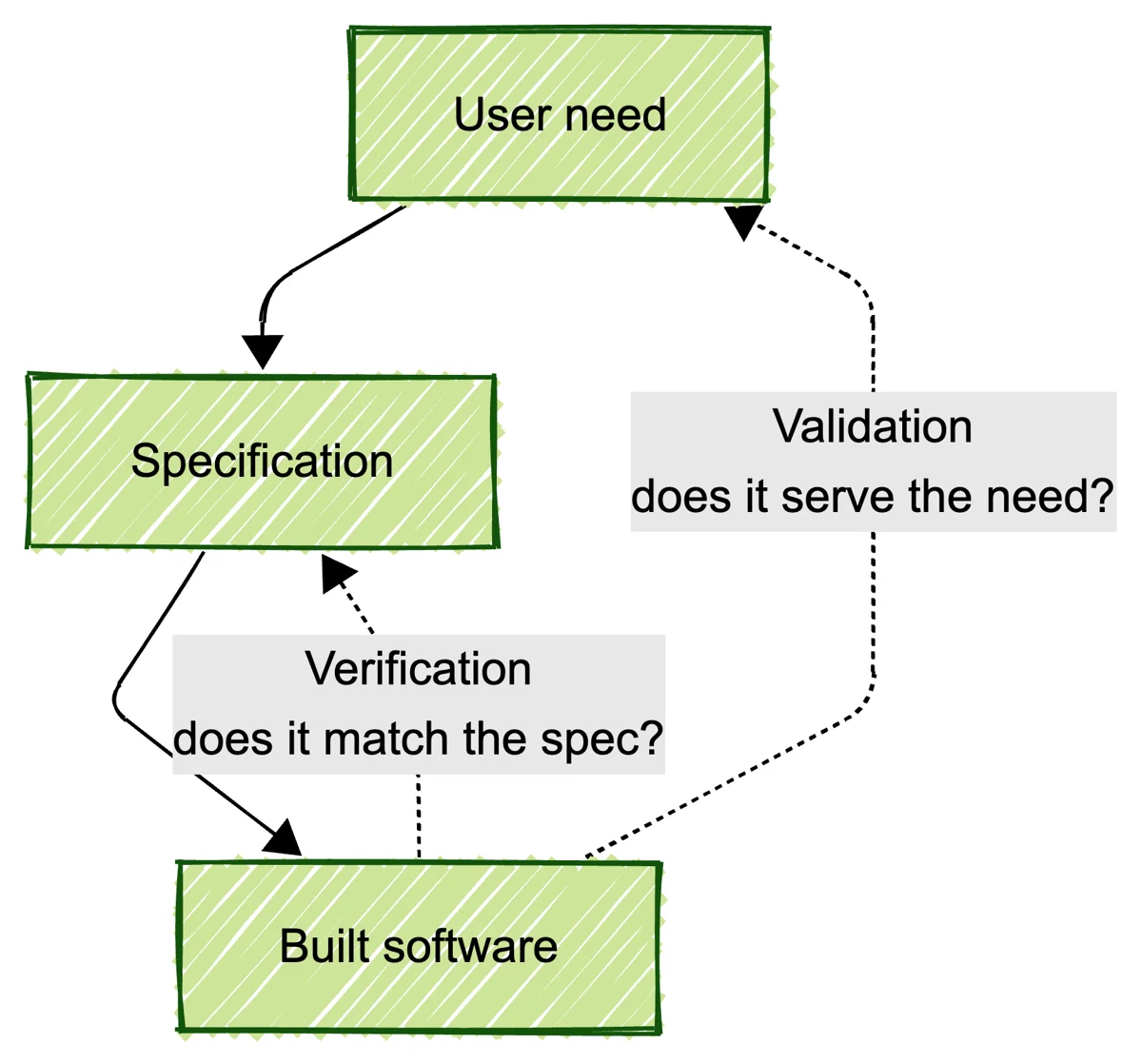
tldr: Verification asks whether you built the product right: does the software match its specification. Validation asks whether you built the right product: does it actually serve the user's need. Verification runs all through development; validation judges the finished result. You can pass one and fail the other.
The difference between verification and validation
| Verification | Validation | |
|---|---|---|
| Question | Are we building the product right? | Are we building the right product? |
| Checks against | Specifications and requirements docs | Real user needs and expectations |
| Type | Mostly static; a test counts when its expected result is the spec | Dynamic: running software judged against intended use |
| When | Throughout development | Toward the end, on working software |
| Methods | Reviews, walkthroughs, static analysis, unit and integration tests | End-to-end testing, user acceptance testing, beta programs |
| Catches | Deviations from the spec | A spec that was wrong to begin with |
The two questions in the first row are Barry Boehm's; he put the pair into circulation in the late 1970s and in Software Engineering Economics. And one qualifier the tidy blog version skips: verification is not purely static. Reviews and static analysis never run the program, but unit and integration tests verify too, because their expected results come from the spec. Validation's expected results come from intended use, and it always needs a running system. An end-to-end test can serve either side, and often serves both.
Verification, in plain terms
Verification is conformance checking. The spec says the password reset link expires in 30 minutes; verification confirms the code does that. Run as a test, that check is requirements-based testing in its purest form, and it sits alongside activities that never execute the program at all: requirements reviews, walkthroughs, static testing.
Much of verification can happen before the software runs. Validation never can.
Validation, in plain terms
Validation is judgment against reality. The software can match its spec line by line and still fail validation, because the spec encoded a wrong guess about what users needed.
The classic example: a team ships an export feature exactly as specified, CSV with fifteen columns. Users needed the export to open cleanly in Excel with dates their finance tool could parse. Every verification check passed. Validation failed the first week.
That is why validation methods involve real usage: acceptance testing with actual stakeholders, beta releases, and full journey tests that mirror what users do rather than what documents say.
Why the pairing matters
Teams that only verify ship faithful implementations of wrong ideas. Teams that only validate catch problems late, when fixes are expensive, because nothing filtered defects out earlier. The pairing works as a funnel: verification removes defects continuously while the software is cheap to change, and validation confirms the assembled product earns its place before release.
In the V-model of the software testing life cycle, every development phase on the left arm has a matching test phase on the right arm. The lower right levels are mostly verification. The top of the right arm, acceptance testing, is where validation lives.
FAQs
Which comes first, verification or validation?
Verification. It starts with the first requirements review and continues through every build. Validation needs working software to judge, so it concentrates at the end of the cycle.
Is end-to-end testing verification or validation?
Both, and that is its value. An end-to-end test verifies the assembled system against expected behavior, and because it replays real user journeys, it doubles as ongoing validation on every deploy.
What does ISO 9000 say about the two terms?
ISO 9000 defines verification as confirmation that specified requirements have been fulfilled, and validation as confirmation that requirements for a specific intended use have been fulfilled. Same distinction: the spec versus the use. IEEE 1012, the software-specific V&V standard, keeps the same split and specifies the verification and validation activities for each life cycle stage.
Can automated tests do validation?
Partially. Automated journey tests validate that intended use keeps working once you know what it is. Discovering what users actually need still requires humans: interviews, beta feedback, and watching real usage.

