
tldr: Selenium is the standard the whole industry was built on. Playwright is what most new teams reach for now. If you are starting a browser-testing suite in 2026, Playwright is the default, and Selenium is the deliberate exception you pick for a reason: a language your team already lives in, a browser matrix Playwright cannot cover, or a grid you are not going to rebuild.
Selenium has been the answer to "how do we automate a browser" for more than a decade. It is a W3C standard, it drives every major browser natively, and it supports more programming languages than anything else on the market. That history is exactly why the question keeps coming up. Teams with a working Selenium suite want to know whether Playwright is worth a migration, and teams starting fresh want to know whether the old standard is still the safe pick.
This is the leader's view of that decision. No code samples. The comparison that actually drives total cost of ownership: where each tool wins, what a migration buys you, and the maintenance bill that neither one erases.
The protocol split that explains everything else
Selenium drives a browser through the W3C WebDriver protocol. Each command is an HTTP request to a driver that translates it into a native browser action. That design is why Selenium reaches so many browsers and languages. Anything that speaks WebDriver can plug in, which is what a standard is for.
Playwright drives the browser over a single persistent connection from an out-of-process Node.js, Python, Java, or .NET runtime. One connection instead of one request per command is why Playwright feels faster and flakes less. It also gives Playwright direct access to browser internals the WebDriver protocol never exposed, which is where auto-waiting and network interception come from.

Hold onto the protocol difference. Almost every practical gap below is a consequence of it.
Auto-waiting is the flake difference
Selenium does what you tell it, when you tell it. If the element is not ready, the command fails, so mature Selenium suites are full of explicit waits that engineers tune by hand. Get the waits wrong and the suite is flaky. Get them too conservative and it is slow.
Playwright waits automatically. Every action checks that the target is visible, attached, and actionable before it runs, and its web-first assertions retry until they pass or time out. Most teams that migrate report the flake rate dropping without anyone writing wait logic. That single behavior is the most common reason a team leaves Selenium.
Browser and language coverage
Playwright drives Chromium, WebKit, and Firefox from one API, with mobile emulation for Chrome on Android and Mobile Safari. Its language list is shorter: Node.js, Python, Java, and .NET.
Selenium officially supports six languages: Java, Python, C#, Ruby, JavaScript, and Kotlin. If your team writes Ruby or Kotlin, Selenium is the only first-class option, and that alone can settle the decision. Selenium also reaches browser versions and real-device clouds that Playwright's patched-binary model does not, which matters when your matrix includes older browsers or a specific vendor grid you already pay for.
Speed, parallelism, and CI cost
Playwright bundles a test runner, parallelization, and sharding. You get parallel execution on day one without assembling it.
Selenium provides the driver and leaves orchestration to you or to Selenium Grid, its distribution server for scaling runs across machines. Grid is powerful and battle-tested, and it is also infrastructure your team now owns and maintains. For a new suite, Playwright's built-in parallelism is less to run. For an organization that already operates Grid at scale, that investment is a reason to stay.
When Selenium is still the right call
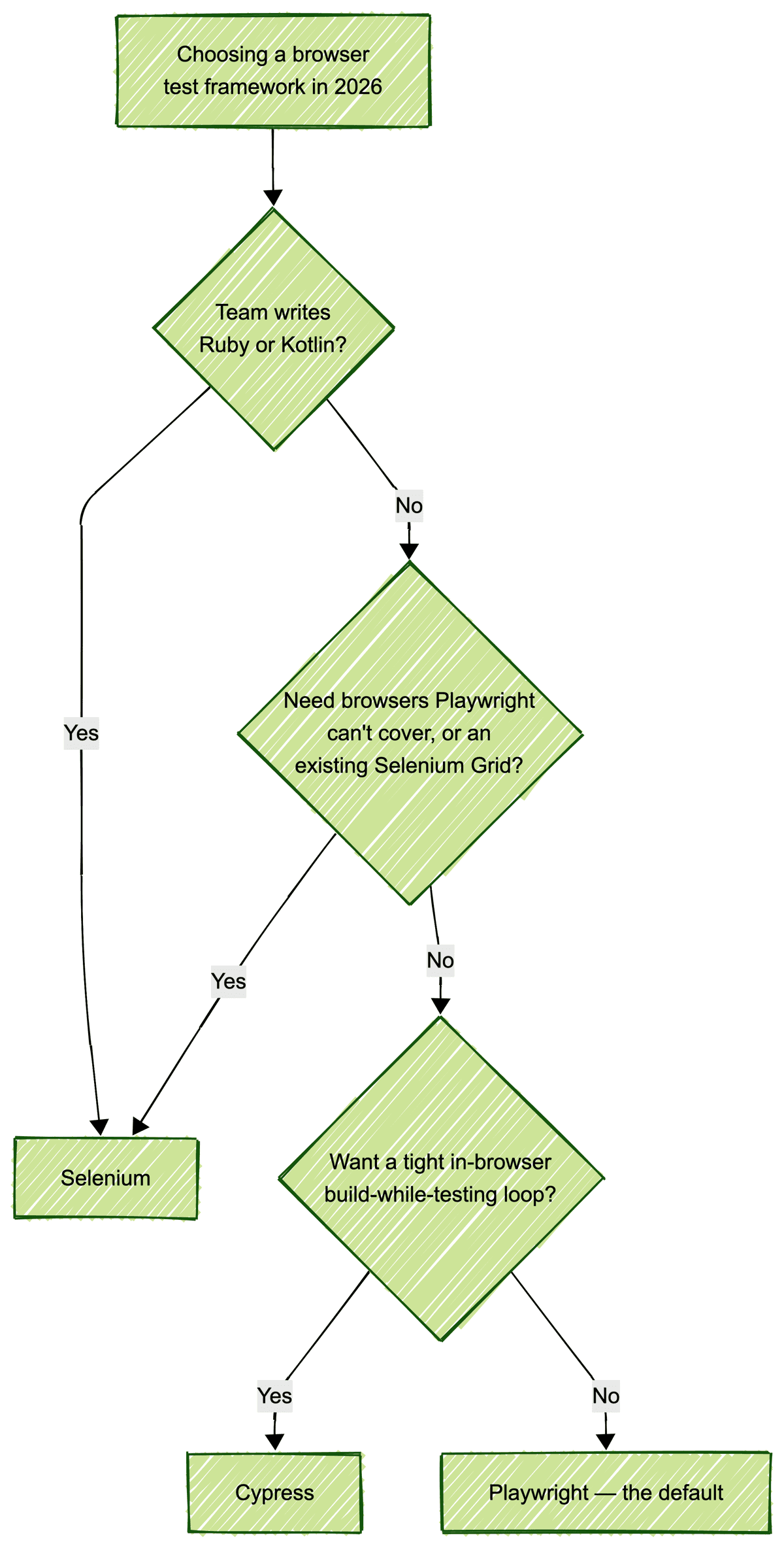
Choosing a Playwright vs Cypress setup is a debate among modern frameworks. Choosing Selenium in 2026 is usually a constraint talking, and the good constraints are real ones: a Ruby or C# codebase your team is fluent in, a compliance requirement to test browsers Playwright does not ship, or a mature Grid and integration ecosystem that would cost more to replace than it returns. Selenium is not deprecated. It is a W3C standard with active BiDi work, and a working Selenium suite is not a liability you have to rush off. It is the exception you keep on purpose.
If none of those constraints apply, "a modern Selenium alternative" almost always resolves to Playwright, which is why it is now the default for greenfield suites.
The cost both tools leave on your desk
Whichever column you land in, you are funding infrastructure. Framework choice, locator strategy, parallel CI, a browser fleet, and the hidden cost of flake are the same problem either way. Migrating from Selenium to Playwright lowers the flake bill. It does not remove the suite you now have to keep current on every deploy.
That standing maintenance load is where Bug0 comes in. A forward-deployed engineer plans the coverage for your critical user flows and builds it on Bug0's AI engine, which runs the tests on Playwright and self-heals them when your UI changes. The browser fleet is ours, the maintenance is ours, and every result is verified by a QA engineer before it reaches your team. The framework underneath is Playwright, which is the one most engineering teams would choose today anyway.
FAQs
Is Playwright better than Selenium?
For most new web-app test suites in 2026, yes. Playwright is faster, flakes less because of auto-waiting, and ships a test runner and parallelism out of the box. Selenium wins when you need a language Playwright does not support, a browser it does not cover, or an existing Grid you are not going to rebuild.
Can Playwright replace Selenium?
For the common case of testing a modern web application in JavaScript, Python, Java, or .NET, Playwright can replace Selenium and usually reduces flake and CI time in the process. It cannot replace Selenium for Ruby or Kotlin projects, or for browser targets outside Chromium, WebKit, and Firefox.
Is Selenium deprecated?
No. Selenium is an actively maintained W3C WebDriver standard with ongoing WebDriver BiDi work. A working Selenium suite is fine to keep. The shift is that most teams starting fresh now pick Playwright.
What is the best Selenium alternative in 2026?
Playwright is the most common answer for teams that want speed and lower flake, and Cypress is the alternative for frontend teams that want a tight in-browser loop. Which one fits depends on your language and browser needs more than on any feature chart.
Does Playwright support more browsers than Selenium?
Not more, but differently. Playwright covers Chromium, WebKit, and Firefox through patched binaries it maintains. Selenium can drive a wider set of real browsers and versions through native drivers and device clouds, which is an advantage for broad or legacy browser matrices.
Should I migrate my whole Selenium suite to Playwright at once?
Rarely. Most teams migrate the flakiest and highest-value flows first, run both in parallel during the transition, and retire Selenium tests as the Playwright equivalents prove stable. A big-bang rewrite carries more risk than the flake it removes.

