
tldr: An LLM as a judge is a language model you point at another model's output to score it. When the thing under test is AI, there is no fixed string to assert against, so you hand a capable model the output and a rubric and let it return a verdict. Strong judges agree with human raters more than 80 percent of the time, and they carry biases you have to design around.
A traditional test assertion checks for an exact result. The total equals 42, the banner contains "Payment received", the response status is 200. That model works right up until the output is produced by an AI, because a correct answer can be worded a hundred ways and none of them match a hardcoded string. Any team shipping an LLM feature runs into it fast. How do you write a pass-or-fail check for a summary, a support-bot reply, or an agent's next action?
Using an LLM as a judge is the working answer. You give a capable model three things: the output, the input that produced it, and a description of what a good answer looks like. It returns a score or a verdict. This is the technique behind most current LLM evaluation and AI eval pipelines, and it is how automated testing keeps functioning once the system under test is no longer deterministic. In the broader AI testing landscape, this is the "testing of AI" branch — the mirror image of using AI to test conventional software.
This page covers what the pattern is, why it beats string matching for AI output, where LLM judges are known to fail, and how the same idea already runs inside test automation.
What an LLM judge actually does
There are two common setups. A pointwise judge scores a single output against a rubric, say a 1-to-5 rating for faithfulness or a boolean for "did it answer the question." A pairwise judge is shown two outputs and picks the better one, which is how model-versus-model comparisons and preference rankings get built.

Either way, the rubric does the real work. A vague instruction like "rate the quality" produces noisy scores. A specific one, listing what counts as correct, what counts as a failure, and what to ignore, produces judgments you can act on. The judge is only as good as the criteria you write for it.
Why deterministic assertions break on AI output
The same prompt can yield different wording on every run, and most of those variations are correct. Exact-match and even fuzzy-match assertions treat that variation as failure, so a suite built on them flags a working feature as broken on every run.
An LLM judge evaluates meaning instead of characters. It can tell that "your order is on the way" and "we've shipped your package" satisfy the same requirement, and that a confidently wrong answer does not, even when the wrong answer is well written. That shift, from matching text to assessing whether the output meets the intent, is why the pattern exists.
A judge is one way to assert on meaning. For the wider set of properties worth checking on a non-deterministic system, including task completion, boundaries and consistency across runs, see AI quality assurance.
Single judge, or a jury
One model judging alone inherits that model's blind spots. A judge that quietly prefers its own family of models, or that rewards longer answers, will bake that preference into every score.
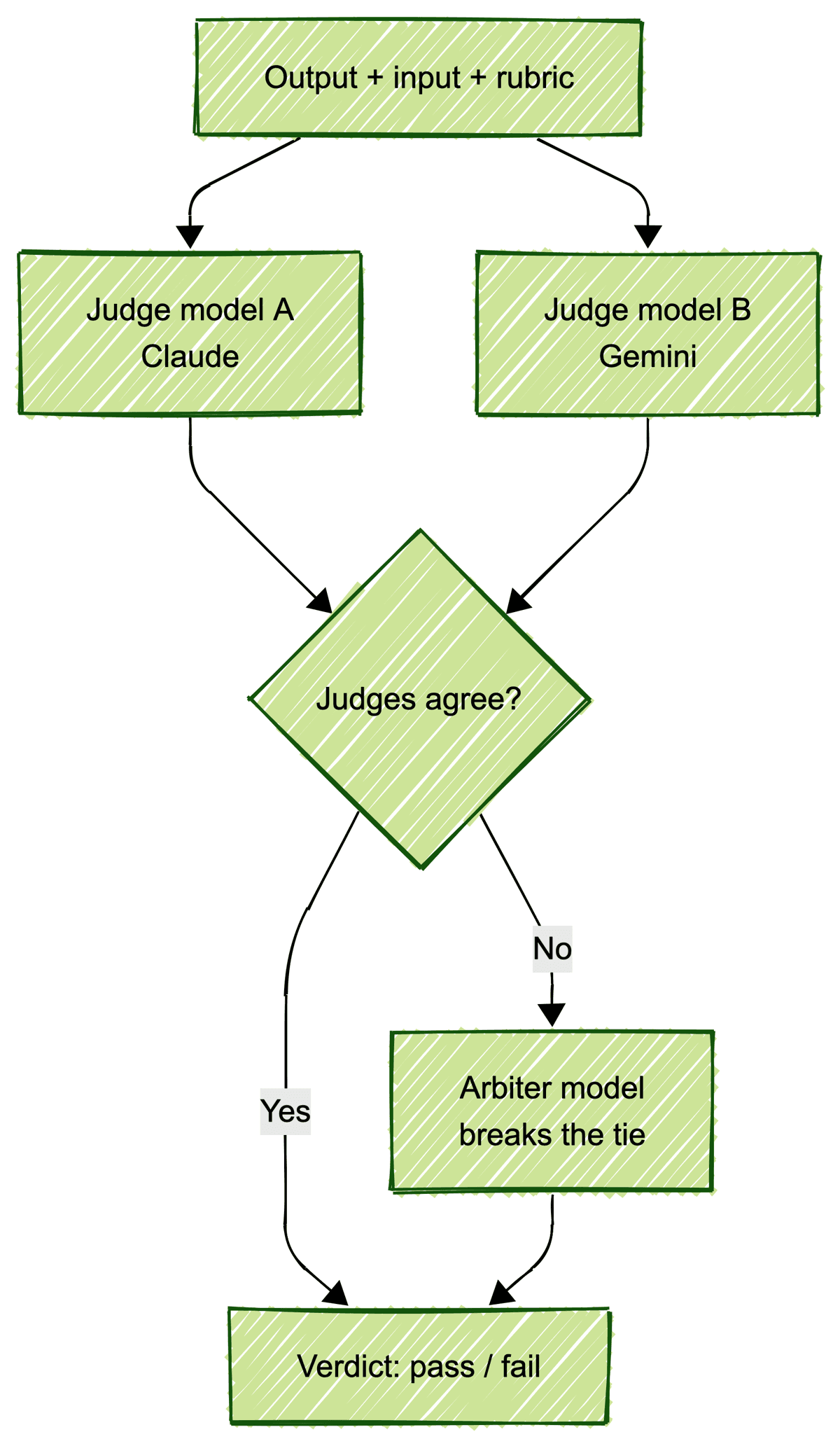
Running several different models as judges and combining their verdicts reduces that risk. When the judges agree, you have a confident result. When they split, a tie-break step decides, either a stronger arbiter model or a defined policy for what a disagreement means. A jury costs more calls than a single judge, and on subjective or high-stakes assertions it is worth the spend.
Where LLM judges go wrong
LLM judges are useful, not neutral. The research that popularized the method, Zheng et al.'s work on MT-Bench and Chatbot Arena, named three biases that still apply: position bias, where the judge favors whichever answer it sees first in a pairwise comparison; verbosity bias, where it rewards longer responses regardless of quality; and self-enhancement bias, where a model rates outputs from its own family more generously. The same work found that strong judges match human preferences well, over 80 percent of the time, which is roughly how often two humans agree.
The practical takeaways follow from that. Randomize answer order to cancel position bias. Cap or normalize for length. Use more than one model family so no single self-preference dominates. And calibrate the judge against a set of human-labeled examples before you trust its scores, the same way you would validate any other measuring instrument.
LLM as a judge inside test automation
This is not only a research technique. It is how an AI-native test runner decides pass or fail on flows that used to need a hardcoded assertion.
Bug0's engine, Bug0 AI, resolves each assertion as an LLM-as-a-judge jury. Claude and Gemini evaluate the assertion in parallel, and an arbiter model resolves any disagreement, which is a direct application of the multi-model, tie-broken design above. It extends to video assertions, where the judge watches a recording of the step to catch ephemeral UI like a toast that a snapshot would miss. On top of that, a forward-deployed engineer reviews the results, so a judge's verdict is checked by a person before it gates a release rather than trusted blindly.
FAQs
What is an LLM as a judge?
It is the use of a language model to evaluate another model's output. You provide the output, the original input, and a rubric describing a good answer, and the judge returns a score or a pass/fail verdict instead of comparing against a fixed expected string.
Is an LLM as a judge reliable?
Reliable enough to be useful, not blindly. Strong judge models agree with human raters over 80 percent of the time, roughly the rate at which humans agree with each other, but they carry known biases and need a clear rubric and calibration against human-labeled examples before you trust the scores.
What biases affect LLM judges?
The most cited are position bias (favoring the first answer shown), verbosity bias (rewarding longer answers), and self-enhancement bias (over-rating outputs from the judge's own model family). Randomizing order, normalizing for length, and using multiple model families reduce each of them.
What is the difference between pointwise and pairwise judging?
A pointwise judge scores one output against a rubric on its own. A pairwise judge compares two outputs and picks the better one. Pointwise fits pass/fail testing; pairwise fits ranking models or comparing versions.
How is an LLM judge different from human evaluation?
A human judge is the gold standard for nuance but does not scale to every test run. An LLM judge scales to thousands of assertions per deploy at the cost of the biases above, which is why calibrating it against human labels matters.
How is LLM as a judge used in software testing?
It replaces the hardcoded assertion for AI-generated behavior. The test runner asks a judge model whether the output met the requirement, often using several models with a tie-break, so a suite can verify summaries, chatbot replies, and agent actions that have no single correct string.

